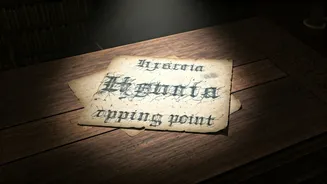








Hysteria's Misogynistic Past
The term 'hysteria,' once a common diagnosis, has a deeply troubling origin rooted in ancient Greek misogyny. Ancient physicians like Hippocrates believed
that a 'wandering womb' (hystera) caused various ailments and emotional disturbances, particularly in unmarried women. Symptoms ranging from emotional outbursts to fainting were attributed to this supposed uterine imbalance. For centuries, marriage and childbirth were presented as the 'cure.' Astonishingly, as recently as the 20th century, 'hysteria' was still exclusively diagnosed in women, often used to dismiss their experiences and complaints. Some 'treatments' even involved surgical intervention, leading to the term 'hysterectomy.' It wasn't until 1980 that 'hysteria' was formally removed from the psychiatric manual, yet the word persists, its loaded history often overlooked despite millions of hysterectomies being performed for valid medical reasons.
Gypped: A Word of Derogation
The word 'gypped,' commonly used to describe being swindled or defrauded, carries a direct link to a historically marginalized group. This term is a corruption of 'Gypsy,' which itself was a derogatory label applied to the Romani people across Europe. These nomadic communities were unfairly stereotyped and accused of nefarious activities such as child abduction, thievery, and deceit. The continuous use of 'gypped' perpetuates these harmful and baseless associations, contributing to the ongoing prejudice faced by the Romani population. Scholars advocate for retiring this word entirely due to its offensive etymology, suggesting alternatives like 'ripped off' or expressing the feeling of being unfairly treated without invoking ethnic slurs.
Tipping Point: Segregation's Echo
While 'tipping point' now describes a critical moment of irreversible change in various contexts, its modern popularization is tied to a painful chapter of American history. The term entered widespread use in the 1950s, during the era of desegregation, to describe the juncture at which white families began abandoning their neighborhoods due to the presence of Black residents. This phenomenon was closely linked to concepts like 'White flight' and 'White fight,' which described efforts to maintain racial segregation. The term 'tipping point' thus carries an unfortunate legacy of racial animosity, serving as a stark reminder of how societal shifts, often driven by prejudice, can be framed by seemingly neutral language. Understanding this origin highlights how language can subtly reflect and reinforce discriminatory attitudes.
Cakewalk: Mockery's Legacy
The phrase 'cakewalk,' used today to signify something exceedingly easy, originates from a deeply ironic and painful past rooted in slavery. On plantations, enslaved Black individuals created a dance as a form of mockery, mimicking the elaborate and often awkward dancing of their white enslavers. Plantation owners, misinterpreting this satirical performance, believed it to be an attempt at imitation and even held contests where the dancers competed for a cake. This practice was later popularized through minstrel shows, further embedding the term in popular culture. The current understanding of 'cakewalk' strips away its historical context of defiance and critique, leaving only the superficial notion of ease, a stark contrast to the oppressive environment from which it arose.
Sarcasm: Words That Wound
The seemingly innocuous practice of sarcasm hides a etymology steeped in aggression. The word originates from the Greek 'sarkázein,' meaning to tear flesh or rip with the teeth, stemming from 'sarx,' meaning flesh or meat. This ancient term conveyed a desire for violence, a wish to inflict pain and draw blood. It evolved through Latin as 'sarkasmos,' signifying mockery intended to wound and humiliate. By the time it entered English in the 1570s, its aggressive undertones were still evident, leading to descriptions of sarcasm as 'biting' or 'cutting.' The very nature of sarcasm, to deliver a stinging remark under the guise of humor, directly reflects its violent linguistic ancestry, highlighting its potential to cause emotional harm.