







New Rafale Deal
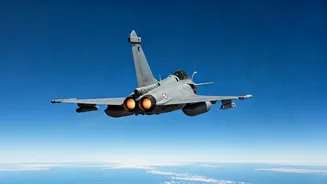
India is moving rapidly to finalize the Request for Proposal (RFP) for a substantial acquisition of 114 new Rafale fighter jets. This crucial step in advancing
the nation's air defense capabilities is happening just before key visits by Prime Minister Narendra Modi and Indian Air Force Chief Air Chief Marshal AP Singh to France. This imminent agreement signifies robust progress in one of the world's most important fighter jet procurements and further cements the enduring defense collaboration between India and France. The plan includes acquiring 22 aircraft in a fly-away condition directly from France, which will also encompass trainer variants to facilitate swift pilot acclimatization. The remaining 92 jets are slated for production within India, through a strategic partnership between Dassault Aviation and a private sector Indian company. This arrangement positions India to become the first nation outside of France to manufacture the Rafale, marking a proud achievement for its burgeoning aerospace sector. The RFP is currently undergoing its final bureaucratic reviews and is expected to be issued shortly. Following the submission of bids by Dassault, subsequent phases will involve intricate price negotiations and detailed contract discussions. A broad government-to-government framework agreement is anticipated during the Prime Minister's visit, with the formal contract signing likely to occur later this financial year or in early 2027. The initial delivery of ready-to-fly aircraft is projected to commence around the year 2030, signaling a long-term commitment to enhancing air power.
Local Manufacturing Push
This monumental deal underscores India's ambitious 'Make in India' initiative within the defense sector. Several prominent Indian corporations, including Tata Advanced Systems Limited, Mahindra, and the Adani Group, are vying to be the local manufacturing partner. The strategy involves issuing manufacturing licenses to at least two Indian firms, after which Dassault Aviation will select its primary collaborator, most likely through the formation of a joint venture. Preparations are already underway, with Indian engineers and technicians undergoing specialized training alongside Dassault teams in France, indicating that the foundational work for this project has discreetly commenced. The final assembly infrastructure could be established in Nagpur, where Dassault currently maintains a presence, or potentially in Hyderabad, reflecting the government's objective to distribute aerospace job opportunities and technological expertise across various regions of the country. India's goal is to achieve an indigenous manufacturing content of 55-60% through phased implementation, pushing for accelerated timelines and a higher proportion of locally produced components than initially proposed. In a related development, Dassault and Tata Advanced Systems are already collaborating on the production of fuselage sections in Hyderabad, with the first components anticipated by FY2028 and a production target of up to two complete fuselages monthly. Complementing this new acquisition, India's Air Force currently operates a fleet of 36 Rafale jets, procured in 2016, which are slated for an upgrade to the advanced F4 standard. This enhancement will introduce superior connectivity, improved data sharing capabilities, and modern communication systems, thereby future-proofing the aircraft.
Strategic Importance
The significance of this impending deal is underscored by its direct continuation of the success achieved with the initial acquisition of 36 Rafale aircraft, which has demonstrably strengthened India's aerial dominance. The Indian Air Force has been operating with a reduced number of squadrons compared to its optimal strength, and the addition of these new jets, potentially forming several additional squadrons, will substantially augment its combat effectiveness and deterrence capabilities, especially in the context of prevailing regional security challenges. Furthermore, this program serves as a tangible manifestation of India's broader strategic objective to achieve greater self-reliance in defense manufacturing, while simultaneously nurturing and maintaining robust strategic partnerships with key international allies like France. This initiative aligns seamlessly with other recent advancements in the country's defense modernization roadmap, including the approval for additional maritime patrol aircraft and the ongoing development of indigenous platforms such as the Tejas Mk-1A fighter jet. The successful execution of this Rafale acquisition and indigenous manufacturing plan will not only enhance India's military posture but also catalyze growth and innovation in its domestic defense industrial ecosystem.