



Arctic's Endless Night
Imagine a realm on our planet where the sun completely disappears for extended periods, leaving behind an unbroken expanse of darkness. This isn't fiction;
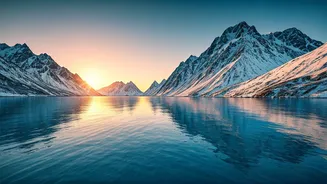
it's a tangible reality in certain remote corners of the globe, most notably in Svalbard, a Norwegian territory situated remarkably close to the Arctic Circle. Here, the conventional rhythm of day and night is dramatically altered, with periods of perpetual darkness becoming a defining characteristic of life. Residents and visitors alike must navigate their days and nights guided by faint twilight or the steady glow of artificial illumination, blurring the lines between what we perceive as a typical day and the deep hours of the night. This profound shift in natural light creates an atmosphere that is both challenging and utterly unique, a stark reminder of the Earth's diverse climatic phenomena.
The Science of Darkness
The intriguing phenomenon of the sun's absence in places like Svalbard is a direct consequence of our planet's axial tilt, which rests at approximately 23.5 degrees. As the Earth embarks on its annual orbit around the sun, different regions of the planet are angled either towards or away from the solar rays for significant durations. In the high-latitude areas near the poles, this tilt results in prolonged periods of daylight during their respective summers and extended periods of darkness during their winters. This specific period of continuous darkness is scientifically termed the Polar Night. In Svalbard's case, the sun abstains from rising from roughly November through January, effectively cloaking the archipelago in near-total darkness due to the Earth's inclination preventing sunlight from reaching these latitudes. Conversely, during the summer months, Svalbard basks in the equally extraordinary phenomenon of the Midnight Sun, where the sun remains visible for 24 hours a day, a mirror image of the winter darkness.
Life in Perpetual Twilight
Sustaining life under the conditions of the Polar Night presents distinct challenges for the inhabitants of Svalbard. The absence of natural daylight for weeks or even months can profoundly disrupt established sleep patterns and impact overall well-being. Furthermore, these dark months are accompanied by extremely frigid temperatures, adding another layer of adversity. However, human resilience and adaptability shine through in these harsh environments. The locals have developed sophisticated strategies to cope with this unique lifestyle. They rely heavily on artificial lighting to maintain a sense of normalcy and structure in their daily routines. Moreover, fostering strong community bonds and engaging in regular social and recreational activities become crucial for psychological well-being, transforming the challenges of perpetual darkness into a testament to human ingenuity and the power of community.
Aurora's Dazzling Display
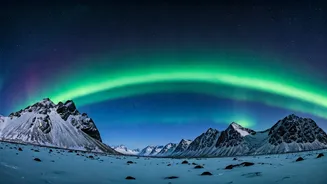
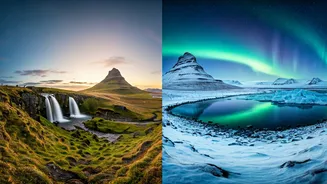
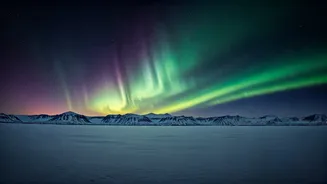
Despite the pervasive darkness of the Polar Night, this period in Svalbard offers a spectacle of unparalleled beauty and wonder: the Northern Lights, or Aurora Borealis. As the skies remain dark for extended durations, the conditions become ideal for witnessing this mesmerizing natural light show. The aurora manifests as vibrant, colorful ribbons of light that dance and shimmer across the celestial canvas, creating an almost magical and ethereal ambiance. For both the permanent residents and the fortunate visitors, this display is a breathtaking reward for enduring the prolonged absence of the sun. The aurora's radiant glow transforms the dark Arctic nights into an unforgettable experience, painting the sky with hues of green, purple, and red, and serving as a stunning reminder of the powerful forces at play in our planet's atmosphere.
Earth's Cosmic Dance
The concept of a place where the sun seemingly vanishes is not a figment of imagination but a captivating natural phenomenon orchestrated by the Earth's celestial ballet. Locations like Svalbard serve as profound reminders of our planet's diverse and awe-inspiring geological and astronomical features. The cyclical nature of day and night, so fundamental to our perception of time and life, can be dramatically redefined by geographic location and the mechanics of planetary motion. This extreme variation in daylight underscores the sheer wonder of our world, illustrating how the basic rhythms of existence can transform completely in different parts of the globe, offering unique perspectives on life and our relationship with the natural universe.