



Origins and History
The origins of tarot cards are shrouded in mystery, with their roots often traced back to 15th-century Europe. Initially, tarot decks were not primarily
used for divination, but rather as playing cards for games. The earliest decks were commissioned by wealthy families and featured elaborate artwork. Over time, the decks evolved, and the symbolic imagery began to deepen. The cards became associated with occult practices and esoteric traditions, particularly in the late 18th century, when figures like Antoine Court de Gébelin and Jean-Baptiste Alliette, also known as Etteilla, began to assign deeper meanings to the cards. These figures laid the groundwork for the divinatory use of tarot that is widely recognized today, linking the cards to concepts of astrology, Kabbalah, and other symbolic systems. This transformation marked the beginning of tarot's journey from a game to a tool for introspection and spiritual exploration, evolving through various interpretations and artistic styles, and cementing its place within modern spiritual practices.
Deck Structure Explained
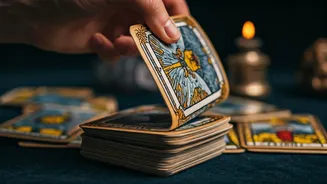
A standard tarot deck consists of 78 cards, split into two main sections: the Major Arcana and the Minor Arcana. The Major Arcana contains 22 cards, each representing a significant life archetype or lesson. These cards are often seen as the core of the tarot reading, conveying major influences, life lessons, and pivotal moments in a person’s journey. Examples include The Fool, The Magician, The Empress, and The Death card. The Minor Arcana, on the other hand, consists of 56 cards, divided into four suits: Wands (representing fire, action, and will), Cups (representing water, emotions, and relationships), Swords (representing air, intellect, and challenges), and Pentacles (representing earth, material possessions, and stability). Each suit has cards numbered from Ace to Ten, followed by four court cards: Page, Knight, Queen, and King. The Minor Arcana provides details and nuances around everyday life, and when combined with the Major Arcana, create a comprehensive picture of the querent's situation.
Symbolism and Meanings
Each card within a tarot deck carries a wealth of symbolic meaning. The imagery depicted on the cards is often rich with symbolism, drawing on archetypes, mythology, and esoteric traditions. For example, The Fool in the Major Arcana signifies new beginnings and a leap of faith. The Magician represents resourcefulness and the ability to manifest one's desires. The Empress embodies abundance, nurturing, and feminine energy, while the Death card, despite its name, represents transformation and the end of a cycle. In the Minor Arcana, the suits add depth to interpretations. Wands often address ambition, career and creativity; Cups deal with emotional aspects and relationships; Swords often relate to challenges, intellect, and conflict; and Pentacles often deal with finances, the physical world and material security. Reading the specific card involves considering not only the imagery and symbolism but also how it appears in relation to other cards in the spread, giving a personalized reading.
Reading and Interpretation
Interpreting tarot cards involves understanding the symbols and their meanings in combination with a variety of reading techniques. Readers often use spreads, which are specific layouts of cards, to address particular questions or to provide an overview of a person’s life. The Celtic Cross spread, for example, is a common layout that explores different aspects of a situation, including the present, the past, challenges, and potential outcomes. When conducting a reading, the reader considers the position of each card within the spread, its interaction with adjacent cards, and the overall context of the question asked. Intuition plays a significant role in interpretation, as readers often draw on their own insights and understanding in addition to the traditional meanings of the cards. Developing proficiency requires practice, study of the card meanings, and a deep appreciation for the symbolic language of the tarot. Readings serve as a guide for self-reflection and decision-making.
Using Tarot for Guidance
Tarot cards are frequently used as tools for self-reflection, offering guidance in many areas of life. The readings can provide insights into relationships, career choices, personal development, and general life paths. By examining the cards, people can gain clarity on their present situation and identify potential challenges or opportunities ahead. The tarot is not meant to predict the future, but rather to shed light on possible outcomes based on current circumstances and to give advice for informed choices. Tarot helps in exploring feelings, beliefs, and attitudes. By asking the right questions and focusing on the underlying messages from the cards, users can gain insights that empower them to make well-informed decisions. Readings encourage introspection, which helps in improving self-awareness and understanding of personal values and motivations.