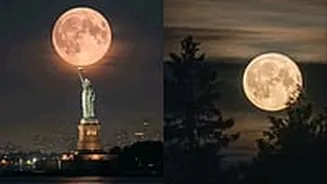







Understanding the Blue Moon
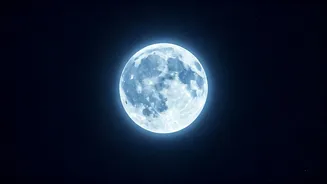
The term 'Blue Moon' often sparks curiosity about the moon's actual color. In astronomy, a 'Blue Moon' refers to the occurrence of a second full moon within
a single calendar month. This is a calendrical phenomenon, not an atmospheric one, meaning it doesn't change the moon's physical hue. Typically, we have twelve full moons in a year, one for each month. However, due to the moon's orbit being slightly shorter than a calendar month, an extra full moon can occasionally fit into a given month. This 'extra' full moon is what earns the 'Blue Moon' designation. It's a rather infrequent event, happening approximately every 2.7 years, making it a notable occasion for skywatchers and enthusiasts alike. The term itself has historical roots, with various interpretations evolving over time, but the modern astronomical definition focuses solely on its occurrence within the month.
Visibility and Timing for India
When a Blue Moon occurs, its visibility is widespread, depending primarily on local weather conditions and the observer's geographical location. For India, the specific date and time of the Blue Moon in 2026 will be crucial for those wishing to witness this secondary full moon. While the moon won't appear blue, the event itself carries a sense of rarity and wonder. The exact timing will be determined by astronomical calculations, aligning with the second full moon of that particular month. Residents across India will have the opportunity to observe this celestial occurrence, provided the skies are clear. Understanding the precise timings, often announced by astronomical organizations, allows for better planning to catch the full moon in its luminous glory, even without a change in its familiar silvery-white appearance.
Meaning and Significance
The 'Blue Moon' has acquired various cultural and metaphorical meanings beyond its astronomical definition. Often associated with rarity and a sense of the extraordinary, it's sometimes linked to a time of heightened intuition or opportunities. While scientifically it's simply an extra full moon in a month, its infrequency has lent it an aura of special significance in folklore and popular culture. In India, like elsewhere, the full moon is already a significant celestial body, often tied to festivals and spiritual practices. A Blue Moon, being an unusual occurrence, can amplify this sense of wonder and auspiciousness. It serves as a reminder of the dynamic nature of celestial cycles and the unique moments they present for observation and contemplation, even if the visual spectacle remains the same familiar lunar glow.