/images/ppid_59c68470-image-178931003360781781.webp)


What is the story about?
For much of the past decade, the business of streaming in India was built on a simple bargain: platforms paid for premium fiction, audiences paid for subscriptions, and producers surrendered control and IP in exchange for scale. That bargain is beginning to look less certain now that Balaji Telefilms, led by Ekta Kapoor, is taking five digital-first fiction series—comprising 200 episodes—exclusively to YouTube.
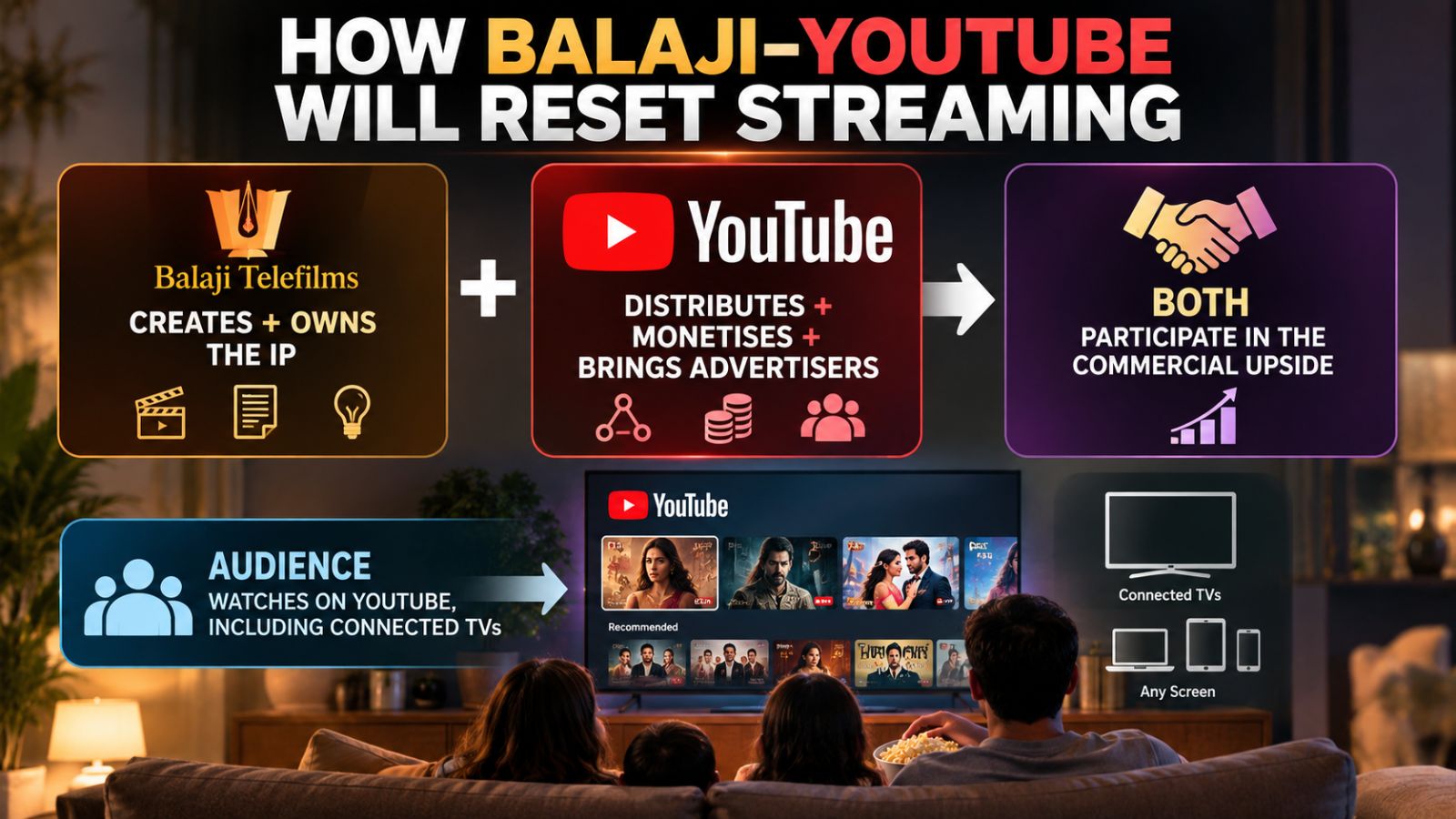
The significance lies not just in where the shows will be watched, but in how they will be monetised and distributed. YouTube brings a global audience and an advertising-led model, while Balaji brings one of India’s most established fiction machines and, crucially, its appetite for building enduring IP. The deal offers a glimpse of a streaming business that may be less about putting content behind a paywall and more about finding the largest possible audience for it.
According to a Business Standard report, YouTube's Gunjan Soni explains, "The future of TV has to be designed around a digital-first audience that wants the best of both worlds: high-quality shows on the biggest screen in the home, with the flexibility of on-demand."
Balaji goes global, YouTube gets fiction
For YouTube, Balaji brings something it has long been chasing beyond creator ecosystems and short-form video: premium, professionally produced fiction. For Balaji, the payoff is scale—a global audience, a new monetisation engine and the opportunity to keep building value around its owned IP.
According to reports, the announced slate includes Haq Se Season 2, a return to the digital drama that began as an ALTBalaji title, and Kehne Ko Humsafar Hai Season 4, another established Balaji digital franchise getting a new chapter. The line-up also includes Phir Pyar Ki Yeh Kahani Suno, a new project that signals Balaji’s continued confidence in its signature territory of romance, relationships and emotionally driven storytelling. Two more shows are currently under development, rounding out a slate that gives YouTube a distinctly Indian premium-fiction offering while allowing Balaji to play to its strongest storytelling instincts.
How does it differ from the traditional OTT commissioning system?
The traditional OTT equation is platforms bankroll premium fiction, control its distribution, and retain the intellectual property. In this arrangement, Balaji keeps 100% ownership of the intellectual property (IP), while YouTube provides the global distribution machine. Instead of simply paying Balaji a fixed production fee, the economics are built around advertising revenue and sponsorships, turning the show into long-term assets on Balaji's balance sheet rather than one-off work-for-hire commissions.
Why does YouTube want expensive, long-form shows?
This is where the television screen becomes critical. While YouTube remains synonymous with mobile video, the platform is aggressively targeting living room viewing via Connected TVs (CTV). Long-form, professionally mounted fiction is key to that push. A viewer watching a 45-minute series on their television is a very different advertising opportunity from someone watching a 30-second Short on a mobile phone. Advertisers pay higher brand-safe, television-like environments, and Balaji's high-volume slate directly fuels YouTube's high-margin CTV ad inventory.
Is it a death knell for the Netflix-Amazon model?
India’s streaming economy has long been predicated on SVOD (subscription video-on-demand) as the primary currency of premium entertainment, but that orthodoxy is facing mounting pressure from escalating content costs, plateauing subscriber growth and the perennial quest for sustainable profitability.
Balaji’s YouTube deal proposes a different equation: retain the IP, take premium fiction global and monetise through advertising and brand partnerships. It may be premature to pronounce the Netflix-Amazon model obsolete, but the deal does challenge the long-standing assumption that premium entertainment must remain sequestered behind a paywall
The significance lies not just in where the shows will be watched, but in how they will be monetised and distributed. YouTube brings a global audience and an advertising-led model, while Balaji brings one of India’s most established fiction machines and, crucially, its appetite for building enduring IP. The deal offers a glimpse of a streaming business that may be less about putting content behind a paywall and more about finding the largest possible audience for it.
According to a Business Standard report, YouTube's Gunjan Soni explains, "The future of TV has to be designed around a digital-first audience that wants the best of both worlds: high-quality shows on the biggest screen in the home, with the flexibility of on-demand."
Balaji goes global, YouTube gets fiction
For YouTube, Balaji brings something it has long been chasing beyond creator ecosystems and short-form video: premium, professionally produced fiction. For Balaji, the payoff is scale—a global audience, a new monetisation engine and the opportunity to keep building value around its owned IP.
According to reports, the announced slate includes Haq Se Season 2, a return to the digital drama that began as an ALTBalaji title, and Kehne Ko Humsafar Hai Season 4, another established Balaji digital franchise getting a new chapter. The line-up also includes Phir Pyar Ki Yeh Kahani Suno, a new project that signals Balaji’s continued confidence in its signature territory of romance, relationships and emotionally driven storytelling. Two more shows are currently under development, rounding out a slate that gives YouTube a distinctly Indian premium-fiction offering while allowing Balaji to play to its strongest storytelling instincts.
How does it differ from the traditional OTT commissioning system?
The traditional OTT equation is platforms bankroll premium fiction, control its distribution, and retain the intellectual property. In this arrangement, Balaji keeps 100% ownership of the intellectual property (IP), while YouTube provides the global distribution machine. Instead of simply paying Balaji a fixed production fee, the economics are built around advertising revenue and sponsorships, turning the show into long-term assets on Balaji's balance sheet rather than one-off work-for-hire commissions.
Why does YouTube want expensive, long-form shows?
This is where the television screen becomes critical. While YouTube remains synonymous with mobile video, the platform is aggressively targeting living room viewing via Connected TVs (CTV). Long-form, professionally mounted fiction is key to that push. A viewer watching a 45-minute series on their television is a very different advertising opportunity from someone watching a 30-second Short on a mobile phone. Advertisers pay higher brand-safe, television-like environments, and Balaji's high-volume slate directly fuels YouTube's high-margin CTV ad inventory.
Is it a death knell for the Netflix-Amazon model?
India’s streaming economy has long been predicated on SVOD (subscription video-on-demand) as the primary currency of premium entertainment, but that orthodoxy is facing mounting pressure from escalating content costs, plateauing subscriber growth and the perennial quest for sustainable profitability.
Balaji’s YouTube deal proposes a different equation: retain the IP, take premium fiction global and monetise through advertising and brand partnerships. It may be premature to pronounce the Netflix-Amazon model obsolete, but the deal does challenge the long-standing assumption that premium entertainment must remain sequestered behind a paywall


/images/ppid_59c68470-image-178946008257372183.webp)