/images/ppid_59c68470-image-179223752676072757.webp)

/images/ppid_59c68470-image-179203005309648882.webp)
/images/ppid_59c68470-image-179203259716885017.webp)
/images/ppid_59c68470-image-179197752711857194.webp)
What is the story about?
After heralding a second mega-successful innings for Amitabh Bachchan at the turn of the new millennium, Kaun Banega Crorepati is now breathing a new lease of life into another superstar’s career.
Madhuri Dixit is hosting the next season of Kon Honar Crorepati, the Marathi chapter of the wildly popular game show. Dixit’s switch to reality television after a spate of middling, forgettable streaming projects highlights yet again that in an industry as ageist and sexist as Hindi cinema, there is no single formula for longevity.
Sustained relevance is a beast few have been able to tame, gender no bar. But it is peculiarly difficult for women to continue to be at the centre of substantial productions as they age.
Also read: 'Ramayana: Part One' clocks over $150,000 in first-day US advance sales ahead of November 5 release
Turn back a few years, and you’d be appalled at how quickly a woman turned from desirable to sacrificial on screen. In the 1970s, Rakhee and Amitabh Bachchan were romantically paired in several blockbusters such as Kabhi Kabhie (1976), Muqaddar Ka Sikandar (1978) and Kaala Patthar (1979). Cut to three years later, she appeared as Bachchan’s mother in Shakti (1982).
It’s been a few decades since. The box has changed. If leading ladies then were reduced to being melodramatic mothers as they aged, today they become tough cops navigating murky investigations in shabbily produced thrillers. Same same but different. Kajol, Raveena Tandon, Karisma Kapoor, Rani Mukerji, Tabu, Kareena Kapoor, the list of heroines going through this new rite of passage is turgidly long.
However, not every maternal role is an artistic defeat. There are characters whose motherhood deepens, expands their lives and then there are ones whose entire identity is defined by it. The same is true for female cops. Despite the deluge, there have been a few clutter-breaking characters that worked against the type and have stayed—Mardaani’s Shivani Shivaji Roy, Drishyam’s Meera Deshmukh.
Tabu may be the clearest example of a leading heroine refusing to confuse relevance with youth. In an exemplary career spanning 41 years, she has moved effortlessly between mainstream Hindi cinema, indie dramas, global productions and regional films in Tamil, Telugu and Malayalam.
From Haider (2014) and Andhadhun (2018) to Fitoor (2016), Golmaal Again (2017), De De Pyaar De (2019) and Bhool Bhulaiyaa 2 (2022), she has repeatedly portrayed women whose motivations resist easy classification.
Her more recent choices further cement her position as that rare female star in Hindi cinema who has made aging irrelevant by embracing it. In Jawaani Jaaneman (2020), she essays the role of a woman whose refusal to play to the type completely dismantles the life of the middle-aged protagonist. In Crew (2024), she plays the eldest of the trifecta of mischief-making air-hostesses negotiating work, money and survival outside conventional respectability.
In Vishal Bhardwaj’s Khufiya (2023), she occupies with remarkable restraint and authority the morally complicated world of espionage. None of these characters are interchangeable, neither are their nuances, desires, and all of them are an absolute hoot to watch.
Tabu has also been unusually candid about the question of age. In 2024, discussing her role in Neeraj Pandey’s Auron Mein Kahan Dum Tha, she said she would not want to play a 30-year-old woman on screen anymore, reiterating that actresses should embrace their actual ages on camera rather than depend on implausible casting or digital de-ageing.
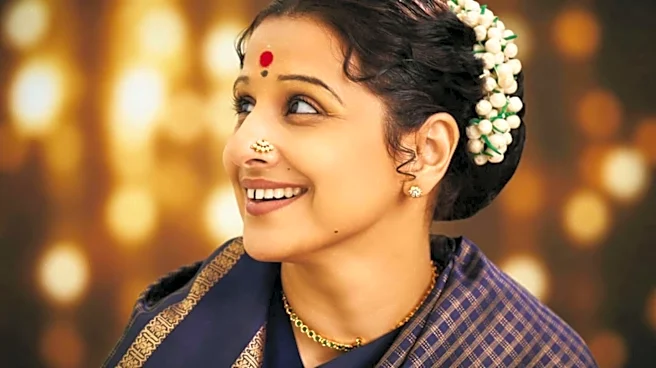
Vidya Balan is another heroine who has been successful in using her might to demonstrate that a Hindi film can be built around a woman who is neither a conventional romantic lead nor a supporting figure in a male star’s story. She started changing the type much before concerns of aging loomed large.
In The Dirty Picture (2011), she challenged the industry's expectations of female sexuality, morality, and desirability. In Kahaani (2012), she made a pregnant woman’s search for her missing husband the engine of an edge-of-the-seat, game-changing thriller that would go on to become a formidable franchise.
In the spate of films that followed—Begum Jaan (2017), Tumhari Sulu (2017), Mission Mangal (2019), Shakuntala Devi (2020), Sherni (2021), Jalsa (2022), Neeyat (2023) and Do Aur Do Pyaar (2024)—she continued to play women whose professional ambitions, eccentricities and private lives were enough to drive a narrative full tilt.
Her presence in the recently released Jailer 2 confirms that Balan is shape-shifting yet again, making a foray in Tamil cinema. Over the years, she hasn’t just helped make female-led films a commercially viable prospect, she has made the Hindi film heroine’s body, age, desires and intelligence legitimate subjects worthy of big-screen exploration and representation.
Then there’s Priyanka Chopra, illuminating yet another path to staying relevant. After establishing a hugely successful career in Hindi cinema, her move to Hollywood (The Matrix Resurrections, Love Again, Heads of State, The Bluff, Citadel) and international reinvention points to a larger possibility.
She’s a testament to how a leading actress can change the terms of her career by changing the market, the genre (she’s really taken to kicking ass), the medium (her foray into television and streaming) or the degree of control she exercises over the work (with Purple Pebble Pictures, she turned producer in 2015).
Her upcoming appearance in SS Rajamouli’s Varanasi also signals a return to a major Indian production, showcasing her willingness to straddle both worlds with ease and power that she’s worked relentlessly to build over time.
Hindi cinema is slowly expanding its vocabulary so it can get better at formulating stories that throb with the kaleidoscopic experiences, concerns and needs of women of all ages.
The most meaningful change, however, is not that an increasing number of older actresses are getting screen time and meaty parts. It is that more and more of them are occupying the centre of stories without having to justify their presence through a man, motherhood, sacrifice or a return to youthful desirability.
Madhuri Dixit is hosting the next season of Kon Honar Crorepati, the Marathi chapter of the wildly popular game show. Dixit’s switch to reality television after a spate of middling, forgettable streaming projects highlights yet again that in an industry as ageist and sexist as Hindi cinema, there is no single formula for longevity.
Sustained relevance is a beast few have been able to tame, gender no bar. But it is peculiarly difficult for women to continue to be at the centre of substantial productions as they age.
Also read: 'Ramayana: Part One' clocks over $150,000 in first-day US advance sales ahead of November 5 release
Turn back a few years, and you’d be appalled at how quickly a woman turned from desirable to sacrificial on screen. In the 1970s, Rakhee and Amitabh Bachchan were romantically paired in several blockbusters such as Kabhi Kabhie (1976), Muqaddar Ka Sikandar (1978) and Kaala Patthar (1979). Cut to three years later, she appeared as Bachchan’s mother in Shakti (1982).
It’s been a few decades since. The box has changed. If leading ladies then were reduced to being melodramatic mothers as they aged, today they become tough cops navigating murky investigations in shabbily produced thrillers. Same same but different. Kajol, Raveena Tandon, Karisma Kapoor, Rani Mukerji, Tabu, Kareena Kapoor, the list of heroines going through this new rite of passage is turgidly long.
However, not every maternal role is an artistic defeat. There are characters whose motherhood deepens, expands their lives and then there are ones whose entire identity is defined by it. The same is true for female cops. Despite the deluge, there have been a few clutter-breaking characters that worked against the type and have stayed—Mardaani’s Shivani Shivaji Roy, Drishyam’s Meera Deshmukh.
Tabu may be the clearest example of a leading heroine refusing to confuse relevance with youth. In an exemplary career spanning 41 years, she has moved effortlessly between mainstream Hindi cinema, indie dramas, global productions and regional films in Tamil, Telugu and Malayalam.
From Haider (2014) and Andhadhun (2018) to Fitoor (2016), Golmaal Again (2017), De De Pyaar De (2019) and Bhool Bhulaiyaa 2 (2022), she has repeatedly portrayed women whose motivations resist easy classification.
Her more recent choices further cement her position as that rare female star in Hindi cinema who has made aging irrelevant by embracing it. In Jawaani Jaaneman (2020), she essays the role of a woman whose refusal to play to the type completely dismantles the life of the middle-aged protagonist. In Crew (2024), she plays the eldest of the trifecta of mischief-making air-hostesses negotiating work, money and survival outside conventional respectability.
In Vishal Bhardwaj’s Khufiya (2023), she occupies with remarkable restraint and authority the morally complicated world of espionage. None of these characters are interchangeable, neither are their nuances, desires, and all of them are an absolute hoot to watch.
Tabu has also been unusually candid about the question of age. In 2024, discussing her role in Neeraj Pandey’s Auron Mein Kahan Dum Tha, she said she would not want to play a 30-year-old woman on screen anymore, reiterating that actresses should embrace their actual ages on camera rather than depend on implausible casting or digital de-ageing.
Vidya Balan is another heroine who has been successful in using her might to demonstrate that a Hindi film can be built around a woman who is neither a conventional romantic lead nor a supporting figure in a male star’s story. She started changing the type much before concerns of aging loomed large.
In The Dirty Picture (2011), she challenged the industry's expectations of female sexuality, morality, and desirability. In Kahaani (2012), she made a pregnant woman’s search for her missing husband the engine of an edge-of-the-seat, game-changing thriller that would go on to become a formidable franchise.
In the spate of films that followed—Begum Jaan (2017), Tumhari Sulu (2017), Mission Mangal (2019), Shakuntala Devi (2020), Sherni (2021), Jalsa (2022), Neeyat (2023) and Do Aur Do Pyaar (2024)—she continued to play women whose professional ambitions, eccentricities and private lives were enough to drive a narrative full tilt.
Her presence in the recently released Jailer 2 confirms that Balan is shape-shifting yet again, making a foray in Tamil cinema. Over the years, she hasn’t just helped make female-led films a commercially viable prospect, she has made the Hindi film heroine’s body, age, desires and intelligence legitimate subjects worthy of big-screen exploration and representation.
Then there’s Priyanka Chopra, illuminating yet another path to staying relevant. After establishing a hugely successful career in Hindi cinema, her move to Hollywood (The Matrix Resurrections, Love Again, Heads of State, The Bluff, Citadel) and international reinvention points to a larger possibility.
She’s a testament to how a leading actress can change the terms of her career by changing the market, the genre (she’s really taken to kicking ass), the medium (her foray into television and streaming) or the degree of control she exercises over the work (with Purple Pebble Pictures, she turned producer in 2015).
Her upcoming appearance in SS Rajamouli’s Varanasi also signals a return to a major Indian production, showcasing her willingness to straddle both worlds with ease and power that she’s worked relentlessly to build over time.
Hindi cinema is slowly expanding its vocabulary so it can get better at formulating stories that throb with the kaleidoscopic experiences, concerns and needs of women of all ages.
The most meaningful change, however, is not that an increasing number of older actresses are getting screen time and meaty parts. It is that more and more of them are occupying the centre of stories without having to justify their presence through a man, motherhood, sacrifice or a return to youthful desirability.



/images/ppid_59c68470-image-17920600296727721.webp)
/images/ppid_59c68470-image-179216005581127416.webp)
/images/ppid_59c68470-image-179196016510351528.webp)