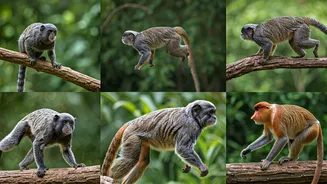








Pygmy Marmoset Marvel
The Pygmy Marmoset, the world's smallest monkey, hails from South America. These tiny primates are a sight to behold, often weighing less than a can of soda.
Their size makes them exceptionally agile, allowing them to navigate the dense canopies of the Amazon rainforest with ease. Pygmy Marmosets are known for their ability to tap into tree bark to access sap, a crucial part of their diet. This specialized behavior, along with their small size, sets them apart in the primate world. These fascinating creatures live a tree-dwelling lifestyle, rarely descending to the forest floor, further solidifying their place in the diverse tapestry of South American wildlife. They are a testament to nature's ability to create unique and perfectly adapted species.
Golden Snub-Nosed Monkeys
Journeying to China, we find the Golden Snub-nosed Monkey. These monkeys are instantly recognizable by their vibrant, golden fur, which contrasts dramatically with their bluish faces. The Golden Snub-nosed Monkey has adapted to harsh, mountainous environments. They spend their days foraging for food in the trees, where they are well-suited to handle the cold. Their social structure is complex, often living in large groups that offer protection from predators and provide opportunities for learning. Their striking appearance, coupled with their resilience, makes them one of the most beloved and studied primates in their native China. They are an essential part of the biodiversity of China.
Bald Uakari's Appearance
The Bald Uakari, a resident of Brazil, is notable for its striking appearance. These monkeys have bright red faces and partially bald heads, which can be an indicator of health. The vibrant coloration of their faces comes from the capillaries close to the skin's surface and helps in regulating body temperature. They are highly social animals, living in large groups within the Amazon Basin, creating a close-knit community. Their unique look makes them stand out amongst all monkey species. This appearance, combined with their social behavior, makes them a crucial species for the ecosystems in which they reside. The Bald Uakari is well-known in the Amazon Basin.
Proboscis Monkey's Nose
Next, we venture to Borneo to meet the Proboscis Monkey. The male Proboscis Monkey is easily identified by its large, pendulous nose, which serves to amplify their calls, and attract mates. These monkeys are primarily found in the coastal mangrove forests and along rivers. They are excellent swimmers, often traveling between trees in search of food. Their specialized habitat and physical features make them one of a kind. Conservation efforts are crucial for the Proboscis Monkey, which faces challenges from habitat loss. Proboscis monkeys are primarily found in coastal regions. Their distinct noses make them well-known in Borneo.
Roloway Monkey of Africa
West Africa hosts the Roloway Monkey, a primate that is known for its distinctive appearance and conservation concerns. They are characterized by their long limbs, giving them a sleek appearance, and a unique beard. Their populations have been dramatically reduced. Their vulnerability has highlighted the need for rigorous conservation strategies to safeguard their survival. The Roloway Monkey represents the challenges faced by primates around the world. These beautiful monkeys are critically endangered, highlighting the need for conservation.
Celebes Crested Macaque
The Celebes Crested Macaque, residing in Indonesia, has a striking crest of hair atop its head, earning it a distinct appearance. This macaque species has a unique lifestyle compared to other monkeys. They have a complex social structure and are recognized for their intelligence. They play an essential role in their ecosystems and are a valuable part of the biodiversity of Indonesia. They face risks such as habitat loss and human interference, which pose significant threats to their populations. Efforts to protect the Celebes Crested Macaque are essential to guarantee their longevity and the preservation of their habitat.
Titi Monkey, South America
Finally, we return to South America to discover the Titi Monkey. These monkeys are known for their strong family bonds and their tendency to pair bond for life. They are often seen with their tails entwined. They have a variety of colors and markings, depending on the species. The Titi Monkeys play an essential role in seed dispersal and the overall health of their forest habitats. They are a great example of social primates. They demonstrate the beauty of primate life. Their existence serves as a reminder of the need to protect the rich biodiversity.