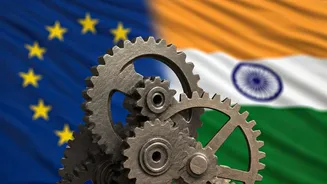








FTA: Key Highlights
The India-EU Free Trade Agreement is designed to significantly reduce trade barriers between the two economic powerhouses. Officials estimate that the FTA
will impact roughly a quarter of the global GDP. According to the agreement, tariffs on 99% of Indian exports to the EU will be eliminated, while duties on over 97% of EU exports to India will be cut. Furthermore, the agreement encompasses crucial pacts on security and defense cooperation and mobility for Indian talents to Europe. These components are intended to strengthen economic ties and strategic partnerships.
India’s Expected Gains
Multiple Indian sectors are poised to benefit from this trade deal. Sectors such as textiles, apparel, leather goods, handicrafts, footwear, and marine products are expected to experience a boost due to increased market access. India also aims to finalize social security pacts with all EU members within five years. The U.S. Trade Representative, Jamieson Greer, noted that India is likely to gain significant advantages from the deal, particularly in terms of market access to Europe. Moreover, the deal is set to create a market of approximately two billion people, and Prime Minister Narendra Modi, along with EU leadership, has unveiled a five-year plan to leverage trade and defense to protect the global order.
EU’s Advantages & Strategy
While India stands to gain considerably, the EU also anticipates substantial benefits from the FTA. Europe is expected to see advantages in sectors like wine, automobiles, chemicals, and pharmaceuticals. The U.S. Trade Representative suggested that the EU is focusing on India as an alternative outlet for its exports, especially as the U.S. may be adjusting its approach to globalization. This shift reflects the EU's need for diverse trade partners and its trade-dependent nature. The agreement may therefore be seen as a strategic move to secure trade channels amid global economic uncertainties and shifting alliances.
US Concerns and Sanctions
The U.S. government has expressed its concerns regarding India's ongoing purchases of Russian oil. The U.S. Trade Representative acknowledged the progress India has made in reducing these purchases but emphasized the need for continued efforts. The U.S. Treasury Department has implemented more significant sanctions recently. India still pays 25% tariffs on top of the 25% reciprocal tariff the Trump administration imposed on the country. Washington is closely monitoring India’s actions and expects it to decrease its reliance on Russian oil. This is set against the backdrop of the FTA, which is aimed at strengthening the economic ties between India and the EU.
Sectoral Impact: Examples
Specific sectors within India are expected to flourish because of increased market access through the FTA. The gems and jewelry sector, for example, is anticipated to become more competitive with global leaders such as China and Thailand. In addition, the pharmaceutical industry in India is poised to gain increased access to the EU market. This increased access will assist in increasing the sector’s global footprint. These sectoral benefits underscore the agreement's potential to drive economic growth and provide new opportunities for Indian businesses across several industries.