




The Orbital Debris Dilemma
Concerns are mounting over the increasing amount of derelict material populating Earth's orbit, a perilous collection ranging from defunct satellites to
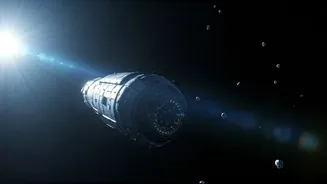
remnants of past space endeavors. This growing accumulation poses a significant risk, potentially leading to a cascade of collisions known as Kessler Syndrome. Experts estimate that millions of objects larger than a centimeter, and tens of millions of smaller fragments, are hurtling through space at speeds exceeding 17,500 mph. This rapid movement, coupled with the sheer volume of debris, creates a hazardous environment for active spacecraft and future missions, making the invisible threat of space junk a critical issue for space exploration and sustainability. Understanding the scale and dynamics of this debris field is the first step in addressing the challenge.
Elusive in Sight
Despite the vast quantities of space debris, capturing it in photographs, even from advanced missions like Artemis II, is an exceptionally rare occurrence. The primary reason for this elusiveness is the sheer scale of the objects; most space junk is minuscule, far too small to be discernible to the human eye or to be captured with any clarity by a camera lens. While the theoretical possibility exists for astronauts to photograph a larger piece, the circumstances required are almost impossibly perfect. The extreme velocities at which both the spacecraft and the debris are traveling create a challenging photographic scenario, making it difficult to focus or obtain a clear image. Consequently, the odds of obtaining a usable photograph of space junk are exceedingly low, rendering it practically invisible in most visual records.
Altitude and Agility
The location of most space debris plays a crucial role in its invisibility during space missions. The highest concentration of orbital junk is found in low Earth orbit, typically residing between approximately 466 and 621 miles above our planet. During the initial phases of a space launch, such as the Artemis II mission's ascent, astronauts are intensely focused on critical flight operations, meticulously managing every aspect of the spacecraft's trajectory and systems. This demanding operational environment leaves virtually no opportunity for them to divert attention or resources to photograph external objects, especially those not directly related to mission objectives. Furthermore, the immense speed at which spacecraft traverse these orbits means that even substantial pieces of debris would flash by almost instantaneously, making identification and detailed capture incredibly difficult, if not impossible, within the limited timeframes available.
Safety Amidst Space
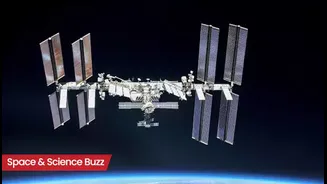
While the visual presence of space junk is minimal in mission imagery, its impact on human spaceflight is a constant consideration. The International Space Station, for instance, regularly experiences encounters with microscopic debris particles. Fortunately, spacecraft like the ISS are engineered with robust shielding and systems designed to withstand impacts from these small fragments, significantly mitigating the risk of critical damage. The probability of a catastrophic collision with larger debris objects remains relatively low, partly due to tracking systems that monitor potential hazards. Although space appears vast, and objects are generally spaced at immense distances, the ongoing problem of space debris is a serious challenge that requires continuous vigilance and technological adaptation to ensure astronaut safety and the success of future space endeavors.