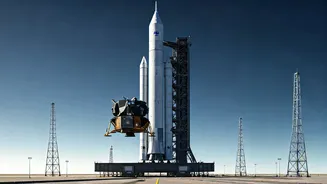








Lunar Mission Prelude
Nasa is gearing up for the Artemis III mission, but with a twist: instead of an immediate lunar journey, it will serve as a comprehensive testbed in Earth
orbit. The primary objective is to iron out any technical and operational challenges that could arise during more ambitious future missions, specifically Artemis IV, which targets a landing near the Moon's south polar region. This strategic approach, focusing on a low Earth orbit demonstration, aims to significantly mitigate risks associated with deep-space travel and complex lunar operations. By conducting these vital tests closer to home, Nasa can refine the capabilities of its spacecraft and the proficiency of its astronauts before they embark on the ultimate goal of reaching the lunar surface. This preparatory phase is considered an essential stepping stone by Nasa officials, ensuring a higher probability of success for subsequent lunar landings.
Orbital Rendezvous Trials
The Artemis III mission's orbital maneuvers will be particularly intricate, involving the Nasa Orion spacecraft and innovative lunar lander prototypes from commercial partners. Orion will be launched atop Nasa's powerful Space Launch System rocket from the Kennedy Space Center. However, in a departure from previous configurations, the rocket will carry a simulated upper stage, a 'spacer' structure that mimics the mass and dimensions of the actual propulsion stage, rather than the functional interim cryogenic propulsion stage. Once Orion achieves orbit, its European-designed service module will be responsible for establishing a stable circular orbit around Earth. This orbital flexibility is crucial, as it allows for optimized launch windows for the various components of the mission, ensuring all elements can converge as planned. The mission architecture is designed to accommodate Orion, a Starship human landing system pathfinder from SpaceX, and a Blue Moon Mark 2 lander pathfinder from Blue Origin, setting the stage for intricate flight tests.
Lander Integration Tests
A significant focus of the Artemis III mission will be the in-flight testing of crucial docking systems and the integration of commercial lander technologies. While final mission plans are still being developed, Nasa has indicated the exciting possibility that astronauts might have the opportunity to enter at least one of the experimental lander vehicles during this Earth orbit phase. This would provide invaluable real-world experience with the lander's interfaces and systems. Furthermore, Artemis III will offer the first opportunity to test Orion's docking system performance while astronauts are onboard and actively engaged in mission operations, allowing them to spend an extended period within the spacecraft's confines, exceeding the duration of the earlier Artemis II mission. This extended time in orbit serves a dual purpose: it allows for thorough testing of the docking mechanisms and provides critical data on crew comfort and operational efficiency during prolonged spaceflights, both essential for future lunar excursions.
Re-entry and Future Scope
Beyond its rendezvous and docking objectives, Artemis III will also rigorously evaluate Orion's re-entry capabilities, with a particular emphasis on its upgraded heat shield. This testing is vital for enhancing the spacecraft's performance during return journeys from the Moon, enabling more adaptable and flexible mission profiles for future lunar explorations. The successful execution of Artemis III hinges on seamless coordination among a multitude of commercial and international partners, making it one of the most operationally sophisticated missions within the Artemis program to date. This collaborative effort underscores the complexity and ambition of Nasa's long-term vision: to establish a sustainable human presence on the Moon and to lay the groundwork for eventual crewed missions to Mars. Each element of Artemis III, from the orbital dynamics to the heat shield's resilience, contributes to this overarching goal.