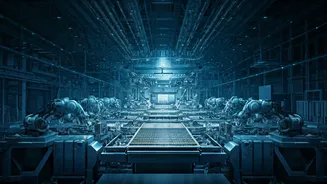








The Grand Vision
Elon Musk has introduced Terafab, a colossal semiconductor manufacturing undertaking, born from the collaborative efforts of Tesla and SpaceX near Austin,
Texas. This advanced technology fabrication plant is designed to achieve an unprecedented annual output of one terawatt of computing power. The primary focus of Terafab is the creation of bespoke artificial intelligence chips tailored for a wide array of Musk's innovative projects. These include enhancing the capabilities of Tesla's electric vehicles, powering autonomous robotaxis, developing the humanoid Optimus robots, equipping SpaceX's satellites for space-based operations, and supporting the advanced AI models developed by xAI. The scale of a terawatt is staggering, representing one trillion watts, a figure that is notably close to the total power generation capacity of the entire United States, underscoring the immense ambition behind this project.
Dual Chip Designs
Terafab will be instrumental in producing two distinct categories of advanced chips, each optimized for specific applications. The first type is engineered for edge or inference tasks, crucial for real-time processing in systems like Tesla's Full Self-Driving (FSD) software, its upcoming Cybercab services, and the sophisticated movements of the Optimus robots. These chips are designed for efficiency and rapid decision-making directly on the device. Concurrently, the facility will manufacture high-performance chips destined for the demanding computational needs of xAI's training algorithms and for the data centers planned for SpaceX's orbital missions. This dual-pronged approach ensures that both localized processing and large-scale AI model development receive the specialized silicon they require to push the boundaries of current technology.
Integrated Operations & Scale
The initial financial outlay for the Terafab project is projected to be between $20 billion and $25 billion, reflecting its significant scale and complexity. This ambitious facility is conceived as an all-encompassing ecosystem, integrating chip design, manufacturing, rigorous testing, and large-scale production. A particularly innovative aspect of Terafab's operational plan involves the potential deployment of Optimus robots to perform various tasks within the factory, automating key processes. Looking further ahead, the vision extends to enabling space-based artificial intelligence through a network of millions of satellites. These orbital systems are envisioned to leverage advanced vacuum cooling technologies and consistent solar power to achieve more cost-effective computing in space, thereby facilitating what Musk describes as 'galactic civilization'.
Scaling to the Stars
The Terafab initiative is set to commence with a smaller footprint in Austin, Texas, before embarking on a massive expansion. The ultimate objective is to achieve a combined terrestrial and orbital power capacity of 100-200 gigawatts on Earth and a remarkable one terawatt in orbit. This phased scaling is intended to provide the foundational computing power necessary to support AI development and deployment across the entire spectrum, from terrestrial applications to deep space. Priority access to the chips produced will be granted to xAI, which now operates as a subsidiary of SpaceX. While Musk has not yet provided a definitive timeline for when Terafab will begin delivering its full output, past ambitious projects have seen timelines adjusted, highlighting the dynamic nature of such cutting-edge endeavors.
Addressing Chip Shortages
The imperative behind the Terafab project is starkly articulated by Musk's declaration: 'We need the chips, so we build the Terafab.' This venture represents a direct response to the escalating global demand for artificial intelligence chips, which has significantly outpaced the production capacities of established semiconductor manufacturers such as TSMC and Samsung. Despite lacking prior direct experience in semiconductor fabrication, Musk asserts that developing Terafab is essential due to the projected exponential growth in computing power requirements for Tesla and SpaceX. The organization's internal needs are anticipated to far surpass what external suppliers can provide, necessitating this bold move towards in-house chip manufacturing. This strategic decision also coincides with SpaceX's recent indication of a recalibration of near-term priorities, with a renewed focus on lunar missions, suggesting that long-term aspirations for a Mars colony may unfold over a more extended period.
In-House Chip Evolution
Musk's foray into custom chip design began with Tesla's Dojo supercomputer, introduced in 2021 with the specific purpose of accelerating the training of its Full Self-Driving software, utilizing proprietary D1 chips. This initial step laid the groundwork for a broader in-house chip strategy. In a significant pivot announced in January 2025, Tesla decided to consolidate its separate chip design efforts, unifying them under a new AI5 chip. Launched in July of the previous year, these AI5 chips were reported to achieve performance levels comparable to Nvidia's Hopper GPUs while consuming considerably less power. This was followed by the development of AI6 chips in April 2026, marking a rapid iteration cycle of approximately nine months. This accelerated pace is critical for keeping up with the rapidly evolving demands of autonomous driving technology and other AI-intensive applications.