




Language Skills Now Crucial
A significant policy shift has been implemented in Maharashtra, requiring taxi and auto-rickshaw drivers to demonstrate proficiency in the Marathi language
to obtain and renew their driving licenses. This mandate, put forth by the state government, intends to bolster the use of Marathi, which holds the status of the official language within the region. Consequently, drivers will be subjected to a Marathi language assessment, designed to evaluate their capacity to comprehend and articulate basic Marathi phrases and sentences. The government's rationale behind this initiative is to enhance the communication experience for drivers interacting with Marathi-speaking passengers and, in doing so, cultivate a greater appreciation for the local language. This development is poised to reshape interactions within the public transport sector across Maharashtra.
Verification Drive Underway
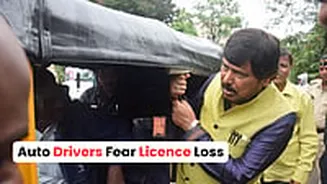
Starting May 1st, autorickshaw and taxi drivers across Maharashtra must prove their Marathi language knowledge, as the transport department gears up for a comprehensive verification drive. This process will span 59 regional and sub-regional transport offices throughout the state. Transport Minister Pratap Sarnaik has clearly stated that drivers must be capable of reading and writing Marathi, issuing a stern warning that failure to meet this requirement could lead to the revocation of their licenses. This stringent enforcement has ignited strong opposition from various drivers' unions, who are concerned about the potential disruption to thousands of livelihoods. They argue that drivers already possess a 'working knowledge' of Marathi, as certified during their initial badge issuance, and view this new mandate as an unnecessary hurdle. The unions have indicated their intention to challenge the decision in court if licenses are indeed cancelled.
Driver Concerns & Union Objections
The new Marathi language mandate has ignited significant apprehension among drivers and their representative unions. Leaders from these associations are voicing strong objections, suggesting that the implementation could inadvertently create avenues for bribery, where non-Marathi speaking drivers might be pressured into paying officials to pass. They contend that the existing provisions under the Maharashtra Motor Vehicles Rules only specify a 'working knowledge' of Marathi, rather than a formal test of reading, writing, or fluency. D.A. Salian from the Mumbai Taxi Association emphasized the unfairness of potentially revoking licenses for drivers who have served for many years, highlighting that families depend on this profession and questioning the retrospective application of such rules. The feasibility of enforcing this rule statewide on all existing drivers, who are already earning their livelihoods, is also being questioned, with warnings of legal challenges if licenses are invalidated.
Government's Defense of Rule
Transport Minister Pratap Sarnaik has defended the Marathi language requirement, asserting that it is not a novel imposition but rather an integral part of the licensing framework for autorickshaw and taxi drivers that has always existed. He cited numerous complaints received from passengers across major regions like the Mumbai Metropolitan Region, Chhatrapati Sambhajinagar, and Nagpur regarding drivers' inability or reluctance to communicate in Marathi. The minister stressed that acquiring the language of the region where one resides and works for a livelihood is a fundamental duty. He encouraged citizens to take pride in their mother tongue while also showing respect for the language of the state they operate in. Furthermore, Sarnaik issued a strong directive to transport officials, warning them against any procedural bypasses and promising strict action against those found to be issuing licenses improperly, underscoring the government's commitment to enforcing the language policy.
Interpreting 'Working Knowledge'
A core point of contention lies in the interpretation of the term 'working knowledge' of Marathi. Union leaders argue that the Transport Minister is overstepping the original intent of the legal requirement. Thampy Kurien, a leader from the Mumbai Rickshawmen’s Union, explained that applicants for public service vehicle badges already undergo rigorous processes including domicile verification and police checks. They also need to demonstrate familiarity with routes and local geography. Kurien clarified that 'working knowledge' simply implies the basic Marathi necessary for everyday communication, not advanced linguistic skills. Drivers themselves are expressing significant concern about the financial implications of this verification exercise. An autorickshaw driver from Mumbai's eastern suburbs voiced his anxiety about potentially losing his income, making it impossible to repay vehicle loans, while another from the western suburbs feared the process could become a pretext for corruption, with officials arbitrarily deciding who meets the language criteria.