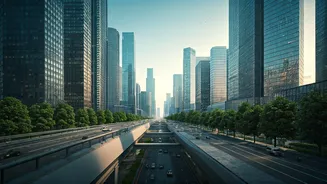









A Visionary Urban Concept
Karnataka is breathing new life into the Greater Bengaluru Innovation and Tech City (GBIT), a vast 7,481-acre AI-centric development poised to transform
the region. This ambitious project, envisioned to foster a sustainable and walkable urban ecosystem, aims to dramatically reduce the daily commute by integrating residential areas, workspaces, educational institutions, recreational facilities, and essential services within close proximity. Located in the South Bengaluru district, GBIT is designed to be India's pioneering and largest AI-focused city, spearheaded by the Greater Bengaluru Development Authority. The township's blueprint emphasizes a 'Work, Live, Play' philosophy, striving for a zero-carbon footprint, zero waste, and critically, zero traffic, by prioritizing pedestrian-friendly zones and extensive cycling infrastructure. This initiative emerges as a direct response to Bengaluru's escalating challenges with traffic congestion and urban sprawl, particularly around its established IT corridors, offering a radical new approach to urban development that prioritizes quality of life and efficient living.
Integrated 'Work, Live, Play'
The Greater Bengaluru Innovation and Tech City is meticulously planned across 7,481 acres, encompassing nine villages in Ramanagara taluk. With an estimated cost of Rs 18,104 crore, this township is founded on the 'Work, Live, Play' principle, aiming to create a self-sufficient urban environment that minimizes the need for long commutes. Instead of segregating work and residential zones, GBIT proposes a co-location of offices, housing, schools, healthcare facilities, and leisure spots within unified urban districts. This model directly addresses Bengaluru's persistent traffic jams and overcrowding issues, which plague areas like Electronic City and Whitefield, where millions commute daily between their jobs and homes. GBIT is strategically positioned to alleviate this by placing commercial and residential spaces adjacent to each other, thereby enhancing the quality of life and reducing travel times significantly. Furthermore, the project is set to catalyze development in Bengaluru's southern region, balancing the city's growth which has historically been concentrated in the north, thereby easing pressure on existing infrastructure and housing.
AI-Powered Infrastructure & Amenities
The proposed AI city is being structured around three core pillars: work, living, and recreation, promising a comprehensive urban experience. At its heart, GBIT will feature a state-of-the-art Central Business District, designed to global standards and specifically tailored for companies operating in cutting-edge fields like artificial intelligence, machine learning, and data analytics. Alongside these large corporate entities and innovation centers, dedicated hubs for startup incubation will foster a dynamic entrepreneurial ecosystem. The residential zones are envisioned to be self-contained communities, equipped with advanced educational institutions, multi-specialty hospitals, expansive parks, and convenient government service centers. A key aspect of GBIT's design includes the integration of AI-enabled civic utilities, promising uninterrupted power and water supply, thereby enhancing the reliability of essential services for its residents. The recreational offerings are equally robust, featuring natural elements like lakes and extensive green buffer zones, alongside cultural spaces and significant sports infrastructure, including plans for an international cricket stadium and Olympic-standard training facilities.
Sustainability and Connectivity Focus
Sustainability is a cornerstone of GBIT's master plan, with approximately 950 acres dedicated to lakes and green buffer zones, reinforcing its commitment to an eco-friendly environment. The township is fundamentally designed around a zero-carbon, zero-waste, and zero-traffic paradigm, promoting a lifestyle centered on walkability and cycling. Connectivity is paramount to the project's success, with direct access planned to major roadways such as NH-275, NH-209, and the NICE Road network. Enhancing its reach, Bengaluru Metro's Phase 3 expansion is slated to extend towards Bidadi, potentially bringing the township within a 30-40 minute commute of central Bengaluru. In a move to further boost connectivity, authorities are exploring the feasibility of a second airport for Bengaluru in the southern region, with potential sites under consideration along Kanakapura Road and the Nelamangala-Kunigal Road corridor. This development, if realized, would not only improve international access to the AI city but also alleviate congestion at Kempegowda International Airport Bengaluru.
Revival and Future Potential
Although GBIT is garnering significant attention now, the concept itself has a history, having remained dormant for approximately 15 years before its revival under the Greater Bengaluru Development Authority. The land designated for this mega-project has already been zoned for development, with preliminary land acquisition processes nearing completion. To ensure the successful execution and implementation of this large-scale urban venture, an international project management consultancy firm is slated to be appointed through a competitive tendering process. If GBIT is developed according to its ambitious vision, it has the potential to set a precedent for future smart city developments across India. It aims to be a holistic ecosystem where advanced technology, environmental consciousness, and innovative urban planning converge to create an unparalleled living and working environment.