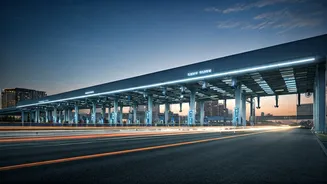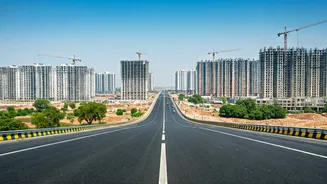







Expressway's Economic Catalyst
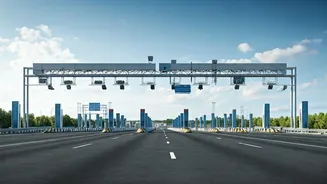
The monumental 1,386-km Delhi-Mumbai Expressway, slated for full completion by 2026, is rapidly transforming into a powerful engine for economic development
and a significant driver of a burgeoning real estate market. Initially designed to cut the travel time between India's capital and its financial hub from a lengthy 24 hours to a more manageable 12 hours at speeds of up to 120 kmph, its impact extends far beyond mere transportation efficiency. The expressway is actively fostering job creation, attracting the development of logistics parks, and stimulating the growth of warehousing facilities along its extensive corridor. This economic uplift is in turn drawing attention and investment from property buyers, turning previously understated Tier-II cities into prime destinations for real estate ventures. This development signifies that the opportune moment for property acquisition is not in the future, but is already unfolding along this vital artery of commerce and connectivity.
Cities Witnessing Growth
The positive economic ripple effect of the Delhi-Mumbai Expressway is demonstrably boosting property values across a diverse range of cities situated along its path, spanning six different states. For instance, Jaipur has experienced a remarkable surge in residential property prices, climbing by 12–18% over the past year alone. Furthermore, projections indicate a substantial expansion of office space in Jaipur, set to grow from its current 7.8 million sq ft to an impressive 13 million sq ft by the year 2030. This growth is partly fueled by the city's competitive edge in office rentals, which are approximately 54% more affordable than those in the Delhi-NCR region, making it an attractive location for businesses and, consequently, their workforces seeking residential accommodations. In Indore, residential property prices saw a healthy rise of 10–15% in 2025, with office and enterprise rental rates settling between Rs 150–200 per sq ft. Further along the expressway's route, areas like Alwar and Dausa in Rajasthan, and various belts surrounding Vadodara in Gujarat, are showcasing clear signs of property value appreciation, with developers actively initiating new housing projects to meet the rising demand.
Property Price Appreciation
The impact of the Delhi-Mumbai Expressway on land and property values within its vicinity has been nothing short of substantial. Specifically, land prices situated within a 50-km radius of the expressway corridor have already seen an impressive increase of 30–40% in numerous stretches. This surge is primarily driven by a heightened demand for land suitable for industrial purposes, as well as for the development of warehouses and extensive logistics parks. The Gurugram-Sohna-Dausa segment of the expressway alone has witnessed an extraordinary jump in land rates, with increases ranging from 60% to 70%. This upward trend is also reflected in property prices in areas like Sohna, which are now reaching Rs 15,000 per sq ft and above, indicating a robust market response to the enhanced connectivity and economic potential brought about by the new infrastructure.
Investment Timing & Outlook
For most urban centers along the Delhi-Mumbai Expressway, analysts suggest that the advantage of being an early investor still holds significant potential. Towns in Madhya Pradesh and Gujarat, in particular, are well-positioned for considerable growth in the logistics and industrial sectors. Projections indicate that land and housing prices in regions such as Vadodara and Bharuch are likely to appreciate by 20–25% over the next three to five years, offering attractive returns. It is crucial to note that the window of opportunity to capitalize on these pre-completion price levels is narrowing. As the expressway nears its full operational status, a subsequent price adjustment is anticipated. Therefore, prospective buyers are advised to consider the current market dynamics and the impending full completion of this critical infrastructure project to make informed investment decisions.
Property Types to Consider
Developers are highlighting that the expressway has significantly reduced transportation costs for businesses, and there remains ample availability of land suitable for establishing new logistics hubs. For individuals looking to invest in residential properties, plotted developments and well-designed gated communities situated in close proximity to expressway interchange points present an optimal balance of affordability and potential for capital appreciation. The broader real estate landscape in India already reflects a growing interest in Tier-II and Tier-III cities, with land acquisition deals in these areas outpacing those in Tier-I cities during the first half of 2025. This trend, where Tier-II and III cities saw 1,907 acres transacted compared to 991 acres in Tier-I cities, clearly signals a redirection of institutional investment towards these developing regions. Essentially, for property investors, the Delhi-Mumbai Expressway acts as a roadmap, indicating the future growth trajectories of various locations across India.