



Cosmic Conjunction Unveiled
From April 16th to April 23rd, the heavens are putting on a remarkable show, presenting a rare opportunity for observers in India to witness an alignment
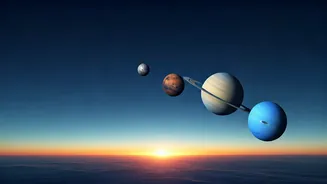
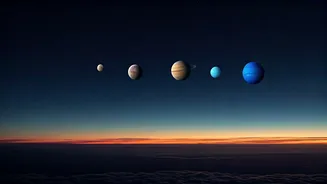
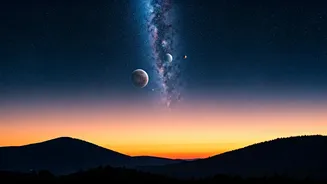
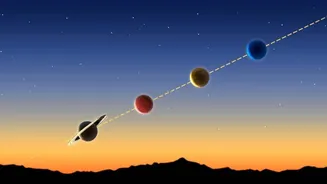
of four distinct planets. This celestial event involves Mercury, Mars, Saturn, and Neptune congregating in the early morning sky. While this phenomenon may create the illusion of planets being close to one another from our perspective on Earth, it's crucial to remember that they remain vast distances apart. The visual alignment is a consequence of their orbital paths around the Sun, which lie along a common plane known as the ecliptic. This shared trajectory allows them to appear in the same section of the sky, offering a fleeting yet captivating glimpse of our solar system's architecture for those keen to wake before the sun. This visual treat is a reminder of the dynamic and interconnected nature of our cosmic neighbourhood, observable with patience and a clear eastern horizon.
India's Viewing Window
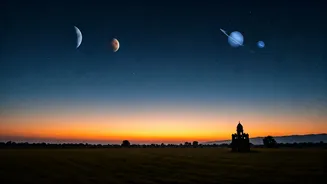
For sky enthusiasts in India, catching this planetary alignment requires an early start, specifically around 30 minutes prior to sunrise. This translates to a viewing period typically between 5:00 AM and 5:45 AM, with the exact timing varying slightly based on your specific location within the country. To maximize your chances of a successful observation, it's imperative to orient yourself towards the eastern horizon. Seek out a vantage point that offers an unobstructed view, free from the interference of tall buildings or excessive artificial light pollution that can obscure fainter celestial objects. The period from April 18th to April 20th is predicted to be the optimal time frame for observing this celestial formation, as the planets will be most favorably positioned and visible as a collective group, enhancing the overall spectacle and providing a clearer view of their arrangement.
What to Seek
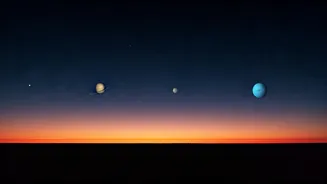
As you gaze towards the eastern horizon during the pre-dawn hours, you'll be able to identify the four planets arrayed at different heights. Mercury, being closest to the Sun, will likely appear very near the horizon, potentially posing a challenge due to the approaching daylight. Its visibility is expected to improve as the alignment progresses towards April 20th. Slightly higher up, you'll find Saturn, recognizable by its gentle yellowish hue; it's generally visible to the naked eye, though binoculars will undoubtedly enhance the viewing experience. Mars will be more readily apparent, distinguished by its characteristic reddish-orange color and its position higher in the sky, making it easier to spot. Neptune, the most distant of the grouping, will be the faintest and will necessitate the use of binoculars or a small telescope for clear identification, as it is not visible under typical naked-eye observation conditions.
Evolving Celestial Dance
The captivating aspect of this particular alignment lies in the dynamic evolution of the planets' spatial arrangement over the observation period. Initially, the planets might appear clustered in a configuration that resembles a triangle, offering a compact celestial tableau. However, as the days progress towards April 20th, this configuration is forecast to gradually shift, transitioning into a more diagonal line. This subtle yet fascinating change allows observers to witness firsthand how the relative positions of these celestial bodies alter over a mere span of a few days. It’s a visual demonstration of planetary motion, providing a unique educational opportunity to see the solar system in action, moving beyond a static image to a developing scene in the morning sky.
A Fleeting Cosmic Event
Alignments involving multiple planets are not exceptionally common, and this particular event stands out due to the clear and compact nature of the planetary grouping. While seeing three planets in close proximity occurs more frequently, the gathering of four planets in such a defined segment of the sky is a genuinely rarer spectacle. For individuals willing to embrace the early morning hours, this week-long astronomical phenomenon presents a straightforward yet profoundly memorable method for engaging with the cosmos. The beauty of this event is that for the majority of the planets, no specialized astronomical equipment is required, making it an accessible experience for anyone with a desire to look up and connect with the wonders of the night sky.