






The Final Moments
The culmination of a monumental task arrived with the final severing of a massive, 30,000-kilogram girder, a process that had stretched over nights filled
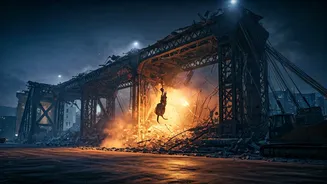
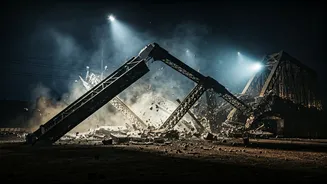
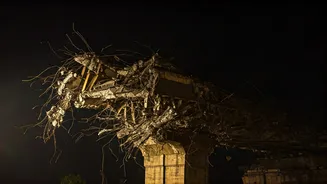
with anticipation and exhaustion. For eight nights, the Indian Express witnessed firsthand the intricate dance of cranes, welders, and workers, often fueled by hurried cups of chai and cigarettes, as they chipped away at the 112-year-old Elphinstone Bridge. The air, thick with dust and the unspoken weight of the endeavor, vibrated with a restless energy. As the last inch of stubborn steel resisted the welder's torch, a collective breath was held. Then, with a final push from a crowbar and the coordinated efforts of workers guiding the ropes, the colossal span swung free. The dawn sky, now fully illuminated, became a canvas for a surprise fireworks display, a silent acknowledgment of the successful completion of a project that had taken over three months of planning and execution. This moment marked the end of an era for a structure that had been an integral part of Mumbai's fabric for over a century, making way for a modern, elevated vision of the city.
A Bridge's Legacy
For more than a hundred years, the Elphinstone Bridge was more than just a physical connection; it was a deeply ingrained part of Mumbai's daily rhythm, a vital artery linking the city's east and west, bisected by the relentless railway lines. Its strategic placement near Prabhadevi and Parel stations made it a desirable nexus for gleaming office buildings and a constant thoroughfare for commuters. The bridge's sturdy, fort-like basalt stone architecture served as a backdrop for the everyday theatre of life, from hurried footsteps to leisurely chats over chai and impassioned debates. However, as Mumbai rapidly evolved, driven by a burgeoning population and an insatiable need for enhanced connectivity, the iconic bridge, like many of its era, became a symbol of the past. In September 2025, its closure was announced, signaling a city-wide transformation where traditional materials like basalt would yield to modern concrete, and the old would inevitably give way to the new. The planned replacement, a double-decker structure, promised to integrate seamlessly with the Sewri-Worli Connector, embodying a future where travel across Mumbai would be measured in minutes, not hours.
Engineering Hurdles
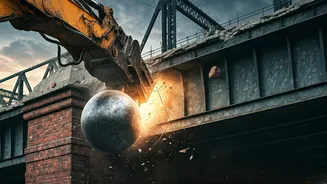
The task of dismantling the 112-year-old Elphinstone Bridge, while seemingly straightforward, presented formidable engineering challenges. Initial assessments of the bridge's original 1911 blueprints revealed natural divisions, separating the structure into three distinct sections, each composed of multiple panels – seven in two sections and eight in the third. This division logically suggested a plan to deconstruct it into its 28 constituent parts. However, two significant complications emerged that demanded innovative solutions. The bridge spanned 11 active railway tracks, necessitating a strict work schedule confined to the narrow three-hour window between the last and first trains of the night, or rare, longer maintenance blocks that could disrupt the city's crucial transportation lifeline. Furthermore, decades of track elevation had caused the overhead electrical (OHE) wires, powering the trains, to creep upwards and become dangerously entangled with the bridge's structure. This entanglement, a consequence of the bridge's limited height of barely 5.5 meters, required a novel approach to safely suspend the OHE wires while sections of the bridge were removed. Project manager Anirudh Sharma devised a clever solution inspired by a clothesline, proposing a temporary beam to support the wires, a concept that eventually gained approval from Western Railway.
Navigating Railway Lines
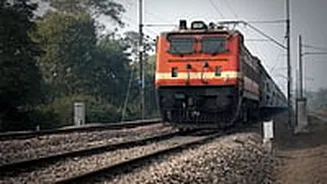
The demolition process over the Western Railway tracks unfolded with a gradual, carefully orchestrated rhythm, despite a few initial setbacks. The first attempt on New Year's Eve proved unsuccessful, and a subsequent attempt on January 3rd, during a rare 12-hour maintenance block, was too ambitious, consumed by the complex task of positioning the crane and a prolonged standoff with local residents. However, as January progressed, the crew found their stride. Nights were dedicated to meticulously cutting the edges of the bridge panels, leaving only the critical four corners intact to maintain the span's stability. This painstaking approach ensured that as the temporary OHE arrangement held firm, the central span over the Western Railway lines could be safely lowered. By the time the crucial central span began its descent on the night of February 16th, the team operated with a practiced efficiency, their sequence of actions resembling a well-rehearsed choreography. As the last train passed around 1:30 AM, a power block was initiated. Railway workers skillfully discharged any residual current from the OHE and then, using an inspection wagon, carefully uncoiled the wires, ducking as they navigated beneath the bridge. Simultaneously, on the structure above, workers armed with gas cutters received the signal, and sparks rained down onto the tracks below. The crane then precisely gripped the panel, and once it was extracted, the temporary beam was swiftly put in place, allowing railway workers to re-secure the OHE. This entire operation was completed by 4:30 AM, demonstrating the team's growing mastery over the complex process.
Central Railway Standoff
While the dismantling over Western Railway tracks was nearing completion, the work over the Central Railway lines faced a significant standstill even before it had truly begun. Despite the successful implementation of the temporary OHE arrangement on Western Railway, Central Railway officials were reluctant to grant approval. Their primary concern revolved around safety protocols, as they deemed the temporary OHE setup untested on their tracks and requested extended timeframes for managing the OHE work during each block. Initially, Central Railway proposed 12-hour blocks, then revised this to six-hour 'megablocks' per panel, effectively doubling the time taken on Western Railway and making such extensive operations feasible only on weekends. This prolonged delay incurred substantial costs, with the 800-ton crane, stationed since late January, incurring rent of approximately Rs 80 lakh per month, a figure that represented half the total dismantling contract cost. Faced with escalating expenses and a lack of progress, project managers Prashant Mishra and Anirudh Sharma considered abandoning the Central Railway phase. However, a crucial intervention by the managing director of MRIDC, who met with Central Railway's DRM, led to a shift in stance. Following the precedent set by Western Railway officials in the initial dismantling phases, Central Railway eventually agreed to cooperate. Although a subsequent road accident involving the crane operator caused another night's delay, once operations resumed, the pace accelerated, culminating in the final megablock on the night of April 5th, which saw the removal of the last girders.