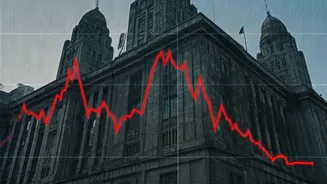







Market Sentiment Unpacked
The recent market downturn in India has been shaped by a combination of factors. Concerns about global economic growth played a significant role. With
many international markets facing similar issues, this affected investor confidence. Furthermore, specific happenings within India's economic sphere, like fluctuations in particular sectors or changes in government policies, also had an impact. These internal factors combined with international trends, collectively influencing the behavior of the stock market. Analyzing both sets of influencers is crucial for understanding the current market mood, which is why it is important to delve deeper into these intertwined elements, so the factors can be examined individually to see how they impact the market's behavior. This breakdown helps investors understand the complexities shaping Dalal Street.
Global Economic Concerns
The global economic landscape plays a vital role in India's market performance. Various international economic challenges have cast a shadow, negatively affecting investor sentiment in India. Rising inflation rates in different countries have led to fears of more aggressive monetary policies, which can reduce investment in equity markets. Additionally, geopolitical tensions and uncertainties in key economies worldwide have added to the apprehension. As global economies slow down or face instability, investors tend to become more cautious. This leads to reduced investments in emerging markets like India, thus contributing to the downward pressure on the domestic stock exchanges. The ripple effect of these worldwide events significantly contributes to Dalal Street's current state, illustrating the interconnectedness of the global financial system.
Domestic Economic Factors
Apart from global influences, domestic economic conditions in India also significantly contribute to market dynamics. Performance within specific sectors of the Indian economy influences investors' confidence. For example, any signs of weakening demand or production issues within major industries can trigger selling pressure in related stocks. The market also reacts to policy announcements by the Indian government and the Reserve Bank of India (RBI). Changes in interest rates, tax policies, or regulatory frameworks can prompt investors to reassess their holdings. Furthermore, corporate earnings announcements are watched closely. Strong earnings typically boost market sentiment, while disappointments can lead to a sell-off. These various domestic factors, ranging from sector-specific dynamics to economic policy adjustments, are essential to consider while analyzing the performance of the Indian stock market.
Impact on Exchanges
The impact of these factors is visible on both the National Stock Exchange (NSE) and the Bombay Stock Exchange (BSE). The NSE, being a leading platform for equity trading, reflects the overall investor sentiment accurately. A downturn in the market, triggered by any combination of global or domestic factors, leads to decreased trading volumes and a fall in index values. The BSE, India's oldest exchange, also experiences similar effects. Changes in market mood are immediately reflected in the BSE's indices and the overall trading activity. A decline in stock prices across various sectors is often evident. These occurrences highlight how closely both exchanges are connected to the overall market sentiment, making them critical barometers of India's economic performance and investor confidence. The fluctuations in NSE and BSE showcase how investor reactions drive immediate impacts within India's financial ecosystem.
Investor Reactions and Strategies
Understanding the interplay of global and domestic influences can help investors formulate suitable strategies during a market downturn. Increased volatility often pushes investors to reassess their risk tolerance and diversify their portfolios. Some may opt to reduce their exposure to equities by moving towards safer assets like bonds or cash. Others might view the dip as an opportunity to purchase stocks at potentially lower prices, following a 'buy the dip' strategy. Furthermore, analyzing the specific sectors affected can help investors make informed decisions. Those who are more risk-averse or uncertain about the market's outlook may choose to adopt a more conservative investment approach. This could include hedging their positions through derivatives or seeking professional financial advice. Adaptive strategies and continuous monitoring of market developments are vital for navigating the dynamic nature of the stock market.