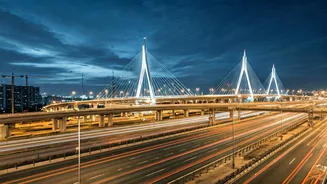








Infrastructure: Key Driver
Infrastructure development has consistently played a pivotal role in propelling India's economic expansion. The government's consistent backing for extensive
projects like roadways, railways, and ports signifies its dedication to bolstering connectivity and trade, both domestically and on a global scale. This strategic focus aims to boost productivity, spur employment, and foster an environment conducive to investment. Consequently, the government has been making substantial financial commitments, resulting in noticeable improvements in infrastructure quality and capacity. By focusing on critical areas and embracing innovative technologies, India is poised to create a modern infrastructure that not only supports current needs but also prepares the nation for future economic challenges. The government's vision emphasizes a seamless integration of different infrastructure components, which is vital for sustained economic advancement and greater social well-being.
Budget 2026: Anticipations
The Budget 2026 holds substantial weight, as it is expected to provide key insights into the upcoming strategic directions for infrastructure development. Experts are keenly observing potential revisions in the allocation of funds to various sectors, forecasting a shift towards projects that prioritize efficiency and sustainability. There is anticipation of a greater emphasis on digital infrastructure, alongside the smart city initiatives, signaling a concerted effort to integrate technology into urban planning. The budget may also introduce initiatives to attract private sector participation, leveraging public-private partnerships (PPPs) to expand infrastructure capabilities. The government is expected to announce its plans to encourage green infrastructure and sustainable building practices to lessen environmental impacts and promote climate-resilient development. This comprehensive approach underscores the government's commitment to balanced and inclusive growth, guaranteeing that infrastructure development benefits all segments of society and contributes to a sustainable future.
Roadways and Railways
The roadways sector is expected to remain a primary focus, given its role in improving connectivity across the nation. Substantial allocations might be earmarked for the construction of expressways, national highways, and rural road networks, with a goal of lessening travel times and improving logistics efficiency. The government is expected to continue supporting the ambitious Bharatmala Pariyojana, an initiative aimed at developing a comprehensive road infrastructure. Simultaneously, the railway sector will likely get significant attention through investments in modernizing existing infrastructure, expanding high-speed rail lines, and improving passenger amenities. The aim is to increase the railway's capacity, enhance safety, and boost its efficiency as a major mode of transportation. Furthermore, the budget is anticipated to integrate smart technologies, such as digital signaling and automated train control systems, in the railway sector. The emphasis on both road and rail infrastructure is designed to stimulate economic activity, promote inclusive growth, and improve the quality of life for all citizens.
Ports and Aviation
The development of ports and aviation infrastructure is expected to be a major feature of the budget. Investments are likely to be directed towards improving port facilities, including capacity expansion, automation, and the enhancement of connectivity to hinterland areas. The aim is to boost trade, reduce logistics costs, and improve India's position in global supply chains. In the aviation sector, the budget may address the expansion and modernization of airports, including the development of new terminals, runways, and air traffic management systems. The government's push for regional connectivity through schemes like UDAN (Ude Desh ka Aam Nagrik) is expected to get continued backing, expanding air travel to underserved areas. This dual focus on maritime and aviation infrastructure will not only improve connectivity but also enhance India's trade capabilities, boosting its economic advancement and global integration. These improvements are crucial to support the increasing demands of a developing economy, facilitating both domestic and international commerce with efficiency and effectiveness.
Digital Infrastructure Push
The Budget 2026 is projected to show a robust commitment to enhancing digital infrastructure. This encompasses investments in broadband connectivity, digital services, and the expansion of the digital ecosystem throughout the nation. A crucial focus area is the implementation of 5G and future advanced communication technologies, which are essential for supporting digital transformation across industries. The government is expected to facilitate fiber optic networks, particularly in rural regions, bridging the digital divide and enabling equal access to information and opportunities. The budget is anticipated to include financial incentives and policy measures aimed at encouraging the development of digital platforms and services. These initiatives support the growth of e-commerce, digital payments, and online education, empowering citizens and fostering innovation. The push towards digital infrastructure is essential for improving India’s global competitiveness, enhancing citizen services, and creating an inclusive digital society that benefits all.
Smart City Initiatives
Smart city initiatives are anticipated to gain prominence within the Budget 2026. The government’s continued backing of the Smart Cities Mission will likely include additional financial allocations for infrastructure projects, technology integrations, and citizen-centric services in the chosen cities. Emphasis is placed on using smart technologies to improve urban living standards by optimizing energy use, water management, waste management, and public transportation systems. The goal is to build sustainable, livable, and efficient urban areas. The budget may also introduce new initiatives to improve the governance and operation of smart cities, including the adoption of data analytics for evidence-based decision-making. Collaboration with the private sector through PPPs is anticipated to be a key strategy for ensuring project success and resource mobilization. These combined efforts are essential to creating innovative urban models that address the specific issues of Indian cities, and contribute to the overall well-being and prosperity of urban populations.
Funding and Financing Strategies
Budget 2026 is expected to outline the funding and financing strategies designed to support infrastructure projects. The government is likely to continue its support for Public-Private Partnerships (PPPs), providing a framework for private sector participation in infrastructure development. This strategy leverages private capital, expertise, and operational efficiency, promoting the swift execution of projects. The budget may also unveil additional measures to encourage foreign investment in infrastructure, offering attractive incentives and a conducive regulatory environment. There could also be increased emphasis on infrastructure bonds and other financial instruments to raise funds. Furthermore, the government may explore innovative financing models, like green bonds, to fund environmentally friendly infrastructure projects. The implementation of robust financial mechanisms is essential for securing funds, supporting infrastructure projects, and encouraging long-term economic growth. The aim is to guarantee that projects are funded in a sustainable, efficient, and transparent manner, ensuring their successful completion and contribution to the nation's progress.
Sustainability and Green Initiatives
Sustainability and green initiatives are anticipated to be major focus areas within the Budget 2026. The government is likely to showcase its dedication to environmentally conscious infrastructure development. This includes allocations to promote renewable energy projects, improve energy efficiency, and build green buildings. The budget might feature incentives for adopting sustainable practices in infrastructure projects, such as using eco-friendly materials and incorporating green technologies. Initiatives to reduce carbon emissions and lessen the environmental impact of infrastructure projects are expected to be unveiled. Focus is also likely to be placed on water conservation, waste management, and the protection of biodiversity within infrastructure projects. The government's emphasis on sustainable practices is vital for fostering environmentally friendly infrastructure development, lessening its ecological footprint, and contributing to the nation’s climate change goals. This comprehensive approach promotes long-term environmental sustainability and guarantees that infrastructure projects benefit both the economy and the environment.