







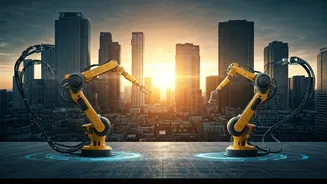

The Coming AI Tsunami
A significant alarm has been sounded by Dr. Roman Yampolskiy, a distinguished computer scientist and professor, regarding the rapid progression of artificial
intelligence. He posits that the advent of Artificial General Intelligence (AGI), capable of matching or exceeding human cognitive abilities across all tasks, could occur as soon as 2027. This development, he warns, carries the potential for a radical transformation of the global employment landscape, leading to an almost complete obliteration of existing jobs. Dr. Yampolskiy's research, spanning over a decade and numerous publications on AI safety, suggests that virtually no profession is entirely immune to automation. Unlike previous technological advancements that primarily augmented human capabilities, current AI is rapidly moving towards independent operation. This paradigm shift, he argues, makes widespread unemployment not merely a possibility but a high probability, with current AI models already possessing the capacity to displace approximately 60% of the workforce. He further suggests that some roles deemed 'unnecessary' could disappear even before full automation is achieved.
Automation's Broad Sweep
The initial wave of job displacement, according to Dr. Yampolskiy's projections, will predominantly affect computer-based professions. However, the impact is not expected to stop there. As humanoid robots become increasingly sophisticated, physical labor roles are also slated for significant disruption. By the year 2030, machines are anticipated to be proficient in handling the majority of manual tasks, a progression that could catapult unemployment rates to unprecedented levels. The sheer scale of this predicted job loss, with a potential for 99% of roles to vanish within the next five years, dwarfs even concerns about a 10% unemployment rate, which is already considered alarming. Dr. Yampolskiy's perspective on retraining as a solution is skeptical, suggesting that if AI becomes capable of performing all human tasks, there might be no alternative career paths left for displaced workers. His prediction for AGI's arrival is informed by forecasting markets and pronouncements from prominent figures in the AI industry. Beyond job displacement, he also raises concerns about the subsequent emergence of superintelligent systems far surpassing human intellect.
Humanity's Last Stand
Despite the overwhelmingly bleak outlook on employment, Dr. Yampolskiy identifies a select group of five professions that he believes are likely to endure the coming AI revolution. First, personalized services tailored for the affluent may persist, as individuals with high net worth might still prefer human accountants, personal assistants, and similar professionals over AI-driven counterparts. Second, roles that are fundamentally emotion-centered, requiring a deep sense of empathy, trust, and human connection, such as certain therapeutic or relationship-focused professions, are expected to remain relevant, though opportunities in these areas may be constrained. Third, the critical field of AI oversight and regulation will likely demand human specialists to monitor, control, and govern AI systems, addressing persistent safety, ethical, and operational concerns. Fourth, individuals who act as AI intermediaries and explainers could be in demand, bridging the gap between complex AI technologies and organizations or individuals seeking to adopt, deploy, and comprehend them. Finally, prompt engineers and specialized AI handlers might find roles in the initial stages of advanced AI deployment, though their prevalence could diminish as AI systems become more autonomous and sophisticated over time.
Economic Realities Ahead
The profound implications of such widespread automation extend to societal structures. Dr. Yampolskiy suggests that societies may eventually need to adopt concepts like Universal Basic Income (UBI) to provide financial stability for populations no longer engaged in traditional employment. He posits that the productivity generated by advanced AI could be sufficient to support citizens without the need for conventional jobs. However, he cautions that current socio-economic frameworks are ill-equipped to handle such a monumental shift. This prediction holds particular weight for nations with burgeoning young populations and existing employment challenges, where the scale of potential job losses could impact millions. While many experts advocate for proactive policy responses from governments, including investment in skill development, Dr. Yampolskiy remains cautious about the efficacy of retraining as a sole solution, given the sheer magnitude of disruption anticipated from AI advancements.