
Pin's Two Essential Parts
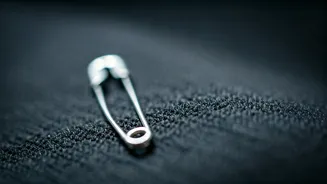
The safety pin’s design showcases a remarkable interplay of two fundamental components. At the core, you’ll find the wire, cleverly shaped into a loop
or coil. This coil operates as a spring, storing potential energy. The spring's inherent tension is vital; it presses the sharp tip firmly in place, preventing accidental opening and potential harm. Without this constant pressure, the pin would be prone to opening up, making it a hazardous object. This thoughtful design transforms a sharp implement into a safe and secure fastener, illustrating the brilliance of functional simplicity.
Ancient Origins of Pins
The safety pin has a rich history that stretches back to antiquity. The ancestors of modern safety pins, called fibulae in Latin, first emerged during the Bronze Age, primarily in Europe. The early versions of this tool were quite different from the contemporary design. For example, pins used in Central European, Greek, and Italian traditions shared a closer resemblance to the modern version, constructed from a single wire. This wire featured a spring in its centre, providing the necessary flexibility. One end was sharpened, while the other was bent to secure the tip.
Early Pin Design Methods
Back in those times, there were distinct approaches to manufacturing these pins. The Northern European method, for example, involved a two-part construction without a spring mechanism. One of these pins was designed with a hole, while the other passed through it, attaching into a clasp. This design was much more complex compared to its counterparts. The evolution towards the modern safety pin reflects the gradual refinement of a simple yet effective idea. This involved a search for a more secure and reliable fastening solution.
The Modern Safety Pin
The modern safety pin as we recognize it today, however, is credited to Walter Hunt, who ingeniously crafted the design in 1849. Hunt's invention used a single piece of wire bent to form a spring-loaded mechanism. This spring-loaded design was a significant advancement, providing both ease of use and enhanced safety. Hunt’s innovative approach quickly became the standard, eventually overshadowing earlier, less-efficient designs. His contribution highlights the impact of one person's vision on the way we interact with everyday objects.