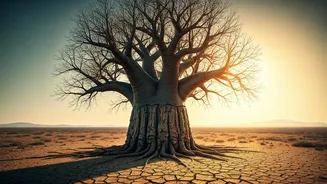







Guardians of Time
Ancient trees, with their imposing stature and deeply rooted presence, serve as living chronicles of Earth's history. These venerable beings have stood
witness to centuries of transformation, offering silent yet profound lessons on enduring hardship, the intricate web of life, and the relentless march of time. In our fast-paced and often unpredictable world, the ancient wisdom held within these magnificent trees provides a grounding perspective. Their existence is a testament to resilience, showcasing how to adapt and thrive despite facing numerous challenges, from harsh weather to environmental shifts. They teach us that survival and growth are often marked by the very experiences that test us, transforming scars into symbols of strength and endurance. Moreover, their interconnectedness within ecosystems highlights our own place in a larger biological community, emphasizing the importance of mutual support and shared existence. The sheer longevity of these trees also offers a humbling lesson in patience and the natural rhythm of life, encouraging us to appreciate the present and find peace in the continuous cycles of growth, decay, and renewal.
Masters of Survival
Exploring the incredible survival tactics of ancient trees reveals a treasure trove of knowledge for science and humanity. Species like the Giant Sequoia, found in California and dating back over 3,300 years, have evolved to harness forest fires for their propagation. Their cones, sealed for decades, open with heat, releasing seeds, while their thick, tannin-rich bark offers protection against flames, pests, and diseases. Indigenous Miwok people understood this relationship, using controlled fires to manage forests and prevent larger conflagrations. Further east, the Qilian Juniper from China's Qinghai-Tibet Plateau, over 2,868 years old, endures extreme droughts, freezing temperatures, and high UV radiation. Its stunted growth and gnarled form have made it a crucial subject for paleoclimate research. In Southeastern Europe, the Bosnian Pine, with specimens like Adonis at 1,075 years old, thrives in harsh mountain environments. Its resilience is evident in its ability to regrow from broken stems after avalanches and its competitive advantage against faster-growing species during fires. These trees demonstrate remarkable adaptations, from utilizing fire and extreme conditions to developing unique protective mechanisms, offering invaluable insights into enduring environmental challenges.
Eco-Adaptations and Lore
The Bald Cypress, with a lifespan exceeding 2,600 years in North Carolina, showcases fascinating adaptations to its watery environment. Its distinctive 'swollen knees' or buttresses, which can rise up to 10 feet, serve as nutrient and carbohydrate storage and facilitate air exchange for submerged root systems. This species is incredibly sensitive to water fluctuations, making its tree-ring data vital for understanding past climate events, including severe droughts that may have impacted early colonial settlements. In Mexico, the Bald Cypress holds cultural significance, often associated with local folklore and even historical moments like Hernán Cortés's reported tears under its shade. New Zealand's Kauri trees, over 2,000 years old, are the largest by volume in the region and are deeply rooted in Maori mythology as descendants of the Supreme Being. Their flaky bark protects against pests, and their extensive root systems prevent soil erosion. Remarkably, Kauri trees exhibit a form of resource sharing through grafted root systems, aiding in mutual survival. These examples highlight diverse strategies—from water management and fire utilization to specialized bark and root structures—that enable ancient trees to persist for millennia, each with its own unique ecological role and cultural narrative.