






Eclipse Unveiled: Date and Time
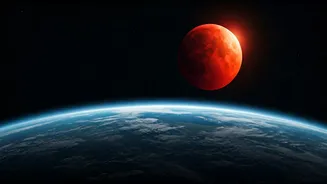
Mark your calendars for a significant astronomical event: the first total lunar eclipse of 2026 is set to grace the skies on March 3rd. This captivating
celestial dance is scheduled to commence around 03:20 PM and conclude by 06:47 PM. Sky enthusiasts in India will have the opportunity to witness the latter stages of this phenomenon, with moonrise expected around 06:26 PM. The peak of the eclipse, where the moon is most deeply immersed in Earth's shadow, will be observable between 06:33 PM and 06:40 PM, with the eclipse officially ending at 06:47 PM. This rare occurrence offers a fantastic chance for both amateur and seasoned astronomers to observe a truly spectacular cosmic display.
Visibility Across India
Exciting news for skywatchers in India: the Total Lunar Eclipse of March 3, 2026, will be visible from the subcontinent. While the entire eclipse might not be observed, the crucial final phases will be clearly seen with the naked eye, making it accessible for everyone. Although the Earth's penumbral shadow begins its contact with the moon earlier in the afternoon, the most dramatic and visible part of the eclipse will occur later in the evening. Astronomers and photography enthusiasts are encouraged to prepare their equipment to capture this memorable event, focusing on the period after moonrise.
Global Viewing Spectacle
The allure of the March 3, 2026, Total Lunar Eclipse extends far beyond India's borders, offering a grand spectacle to numerous countries worldwide. From the diverse landscapes of Australia and New Zealand to the vast expanse of Russia, this celestial event will be a visual treat. Residents of North and South America, as well as entire Asia, will also have the chance to witness the moon transform into a captivating shade. Furthermore, observers in Pakistan, Afghanistan, Iraq, and Iran will be among those privileged to experience this remarkable astronomical phenomenon firsthand.
Sutak Kaal Significance
In alignment with the visibility of the Total Lunar Eclipse in India on March 3, 2026, the period of Sutak Kaal will also be observed. This astrologically significant time will commence at 06:23 AM on the day of the eclipse. Sutak Kaal is considered an inauspicious period in Vedic astrology, and traditional practices often involve abstaining from certain activities during this time. Given the eclipse's timing, the Sutak Kaal may have a notable influence on the celebrations of Holi, a major festival in India, prompting a need for awareness and adherence to relevant customs.
Viewing the Eclipse Safely
Witnessing a lunar eclipse is a straightforward and safe endeavor, requiring no specialized equipment for direct viewing under clear skies. The brilliance of the moon ensures that it can be observed with the unaided eye, providing a stunning experience. For those seeking a more detailed appreciation of the lunar surface and the subtle nuances of the eclipse, utilizing binoculars or a telescope can significantly enhance the view. It is advisable to find a location with an unobstructed view of the eastern horizon to best observe the moon as it emerges and undergoes its celestial transformation.