



The 'Blood Moon' Phenomenon
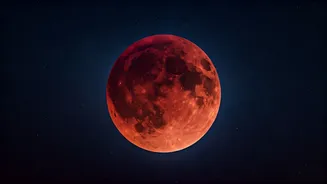
Mark your calendars for March 3, 2026, a date when the night sky will host a total lunar eclipse, a truly magnificent celestial event. Often referred to as
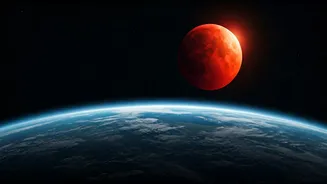
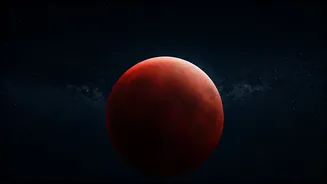
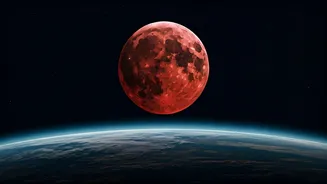
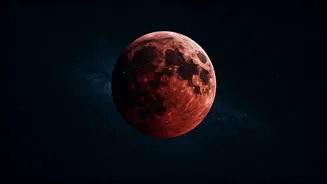
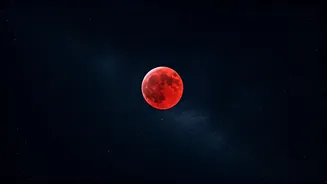
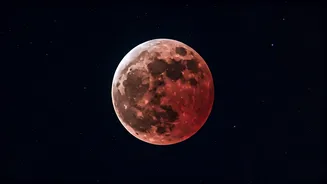
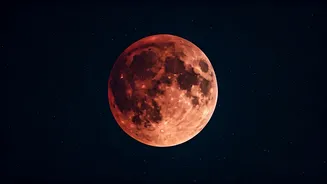
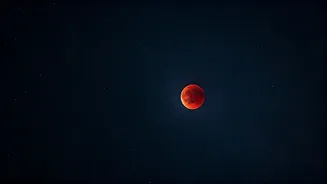
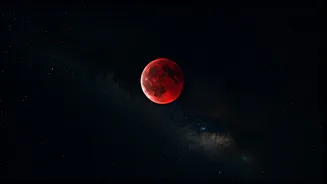
the 'Blood Moon' due to its striking reddish hue, this phenomenon occurs when the Sun, Earth, and Moon align perfectly, with our planet positioned directly between the sun and its natural satellite. As Earth intercepts the sunlight, its shadow is cast upon the Moon, temporarily obscuring it. While this alignment isn't an everyday occurrence, it's a significant astronomical event that sky gazers anticipate with great excitement, promising a viewing experience that is both rare and awe-inspiring for all who witness it.
Why the Reddish Glow?
The captivating crimson color of the 'Blood Moon' is a result of Earth's atmosphere ingeniously bending and scattering sunlight. During a total lunar eclipse, when Earth directly obscures the Moon, some solar rays still manage to penetrate our atmosphere. These rays then refract, much like light passing through a prism. While shorter blue light wavelengths are diffused and dispersed by atmospheric particles, longer red and orange wavelengths are less affected and continue their path, eventually reaching the lunar surface. This selective filtering and redirection of light is what imparts the Moon with its characteristic, deep reddish tint, earning it the evocative nickname 'Blood Moon'.
India's Lunar Eclipse Viewing
For sky watchers in India, the lunar eclipse on March 3, 2026, will present a unique viewing scenario classified as a 'moonrise eclipse.' This means that by the time the Moon ascends above the horizon in various parts of the country, the eclipse will have already commenced. Consequently, the initial phases of the celestial event will not be observable from India. Viewers will be able to catch the eclipse only after the Moon has risen, and the duration of visibility will vary depending on their specific location within India. For instance, in Delhi, the Moonrise is expected at 06:22 PM, while in Lucknow, it will be at 06:02 PM, in Chennai at 06:21 PM, and in Hyderabad at 06:26 PM.
Eclipse Timings and Peak
The total lunar eclipse on March 3, 2026, is scheduled to occur from 03:20 PM to 06:47 PM. The most dramatic phase, when the Moon is fully immersed in Earth's shadow and displays its deepest 'Blood Moon' hue, will take place between 06:33 PM and 06:40 PM. While the eclipse begins in the afternoon, India will primarily witness the latter part of this event after moonrise. The eclipse will officially conclude at 06:47 PM, offering a window for observation, particularly during the maximum eclipse period and just before it ends.
Global Visibility Snapshot
While India experiences a 'moonrise eclipse,' other parts of the world will have different viewing conditions for the March 3, 2026, total lunar eclipse. In the United States, the eclipse will be visible in the early morning hours. For example, Los Angeles will see it around 3:04 AM, Denver at 4:04 AM, and Chicago and St. Louis at 5:04 AM. Further east, New York and Washington will experience the event starting at 6:04 AM. This wide geographical visibility highlights the global reach of this stunning astronomical phenomenon, allowing diverse audiences to witness the Moon's transformation.