







DMK's Political Fortress
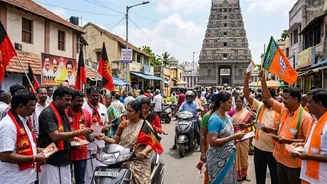
The political landscape of Tamil Nadu is gearing up for a significant electoral battle, with the upcoming polls scheduled to take place on April 23rd.
A central question revolves around the endurance of the Dravida Munnetra Kazhagam's (DMK) formidable hold on power. For years, the DMK has cultivated a strong base of support, often referred to as its 'fortress,' which has allowed it to maintain a dominant position in state politics. This deep-rooted influence stems from various factors, including its historical legacy, consistent engagement with regional sentiments, and a well-established party machinery. The party's ability to connect with a broad spectrum of the electorate, particularly in rural areas and among specific social groups, has been a cornerstone of its electoral success. As the election date approaches, all eyes are on whether this established strength will withstand the challenges posed by rival parties and shifting political tides. The DMK's strategic campaigning and its capacity to mobilize its voter base will be crucial in determining the outcome of this crucial election.
BJP's Chennai Aspirations
In the same electoral arena, the Bharatiya Janata Party (BJP) faces a unique and perhaps unprecedented opportunity to make significant inroads, particularly within the key urban center of Chennai. While the BJP has a national presence, its electoral performance in Tamil Nadu has historically been modest compared to regional heavyweights. However, the upcoming polls present a potential turning point, with the party aiming for a rare success within the capital city. Chennai, being a major metropolitan hub with a diverse electorate, offers a different set of challenges and opportunities compared to the rest of the state. The BJP's strategy in this region likely involves focusing on urban issues, appealing to specific demographic segments, and leveraging national narratives. The AIADMK, a former ally, is also part of the electoral mix, adding another layer of complexity to the alliances. The success of the BJP in Chennai could be a significant indicator of its growing influence in South India and could reshape the state's political dynamics for years to come. This ambition in Chennai represents a high-stakes endeavor for the party.
The Multi-Cornered Contest
The political stage for the Tamil Nadu elections is set for a complex and dynamic multi-cornered contest, featuring a diverse array of alliances and individual party efforts. With voting slated for April 23rd across 234 seats, the election is far from a simple two-party showdown. The DMK-Congress alliance stands as a significant bloc, aiming to leverage their combined strengths. Opposing them is the alliance involving the BJP and AIADMK, presenting a formidable challenge. Adding further complexity to the fray is the Tamilaga Vettri Kazhagam (TVK), which brings its own set of supporters and regional appeal into the mix. This fragmentation of political forces means that voters will have multiple choices, and the outcome could be influenced by a variety of factors, including local candidate strength, regional party influence, and the national political narrative. Such a multi-faceted competition often leads to intricate coalition-building post-election and requires parties to engage in broad outreach to capture a sufficient share of votes across different demographics and regions. The interplay between these various political entities will define the narrative and the eventual results of this crucial election.