




The Timeless Legend
Holika Dahan's narrative is steeped in the epic story of Prahlad, a devoted follower of Lord Vishnu, and his tyrannical father, Hiranyakashipu. Hiranyakashipu,
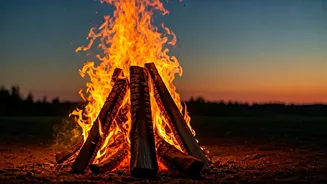
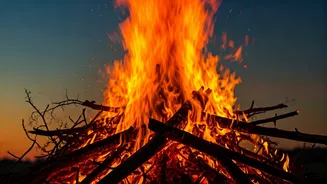
blessed with near invincibility, was enraged by his son's unwavering faith. In a desperate attempt to extinguish Prahlad's devotion, he enlisted the help of his sister, Holika, who was granted immunity to fire. The plot was for Holika to sit in a blazing pyre with Prahlad in her lap, intending for the flames to consume Prahlad while Holika remained unharmed. However, divine will intervened, and Prahlad emerged miraculously unscathed, while Holika perished in the fire. This profound event underscores the eternal victory of righteousness over wickedness, a central theme commemorated each year through the ceremonial bonfire.
Rituals & Preparations
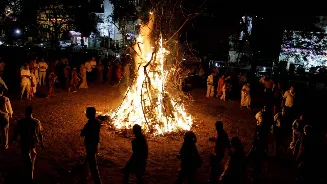
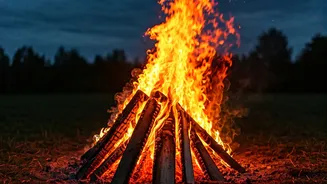
The preparation for Holika Dahan involves a communal gathering of wood and other combustible materials, symbolizing collective spirit. As the auspicious evening approaches, communities engage in Holika Puja, often performed at the designated bonfire site or within homes. Effigies representing Prahlad and Holika are placed atop the woodpile, setting the stage for the ceremonial fire. Devotees chant Rakshoghna Mantras to invoke divine protection and ward off negativity. In some regions, a unique custom includes roasting 'jau' (barley) in the sacred flames; this roasted grain is then taken home as a symbol of good fortune. The air buzzes with joy as people participate in dancing, singing, and circumambulating the bonfire, reinforcing religious significance and fostering community bonding.
Sacred Ash Significance
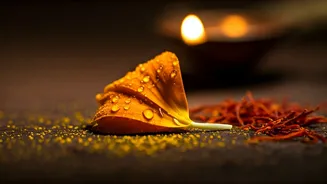
Following the Holika Dahan bonfire, a cherished ritual involves collecting the sacred ash, known as 'Holi Prasad'. This ash holds deep symbolic meaning in the festival's customs. Devotees apply it to their foreheads or limbs as an act of purification and to embody the enduring theme of good conquering evil. This practice is not merely ceremonial; it signifies the continuation of righteousness and invokes blessings for a life filled with prosperity and virtue. Applying the ash serves as a tangible reminder of the triumph of goodness in life's ongoing journey, deepening spiritual connections and spiritual well-being.
2026 Auspicious Timing
For Holika Dahan in 2026, the Purnima Tithi commences on March 2nd at 01:25 PM and concludes on March 3rd at 12:37 PM. The primary Holika Dahan Muhurta is scheduled between 08:55 PM and 10:05 PM on March 2nd, a period of 1 hour and 9 minutes, observed during Pradosh Kaal, carefully accounting for the Bhadra period. Specifically, Bhadra Punchha spans from 08:55 PM to 10:05 PM, followed by Bhadra Mukha from 10:05 PM to midnight. An alternative Muhurta, often followed in North India, suggests performing the ritual after Bhadra ends post-midnight, falling between 12:58 AM and 06:39 AM on March 3rd, offering a substantial window of 5 hours and 42 minutes.
Thandi Holi Ritual
In certain regions of Northern India, the celebration includes a unique tradition known as 'Thandi Holi,' observed in the afternoon before Holika Dahan, primarily by married women. This ritual involves a day-long fast observed until the evening puja, signifying devotion and commitment. As dusk settles, families convene for the puja, seeking blessings for their loved ones and offering prayers to Holika. The fast is broken with a shared meal, strengthening familial bonds and celebrating together. Thandi Holi highlights the importance of familial ties and collective well-being within the broader Holi festivities.