





The Five Pillars
Feng Shui, an age-old Chinese practice, focuses on aligning individuals with their surroundings to promote balance and positive energy flow. At its heart
are five fundamental elements: Wood, Fire, Earth, Metal, and Water. These are not merely physical substances but represent dynamic energies that interact cyclically, influencing various aspects of life, from personal relationships to professional success. Understanding these elements and their interrelationships is key to cultivating a harmonious and prosperous existence. Each element is associated with specific directions, colors, shapes, and qualities, offering a comprehensive framework for environmental harmony and personal well-being.
Wood and Fire Energy
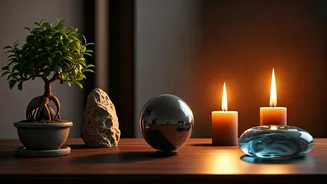
The Wood element embodies growth, vitality, and creativity, symbolizing renewal and expansion, much like spring. Its energy is upward-moving, associated with the East, and represented by green hues, rectangular forms, and natural wood or plants. Incorporating Wood elements can foster family bonds and career advancement. Conversely, the Fire element signifies passion, energy, and transformation, akin to the vibrancy of summer. It's linked to the South and characterized by triangular shapes and radiant colors like red. While Fire can bring fame and recognition, its excessive presence can lead to burnout, so balance is crucial. Utilizing red decor, candles, or adequate lighting can ignite enthusiasm but should be managed to ensure a steady flow of positive chi.
Earth and Metal Stability
The Earth element is the cornerstone of stability, nourishment, and grounding, reflecting the center and its supportive nature. Associated with relationships and education, it is represented by square shapes and earthy tones. Incorporating elements like ceramics, crystals, or natural earthy textures helps in grounding home energy and encouraging a positive chi flow. The Metal element, on the other hand, represents clarity, precision, and intuition, aligning with the harvesting season of autumn and the West direction. Its energy is often depicted by circular forms. White, gray, and metallic colors, along with metallic objects or round mirrors, can enhance focus, discipline, and attract wealth, bringing a sense of order and efficiency.
Water's Flow and Wisdom
Water, the fifth element, symbolizes wisdom, flow, and abundance, mirroring the reflective stillness of winter and the North direction. Its energy is fluid and often represented by wavy shapes. The introduction of blue and black colors, water features like fountains, aquariums, or mirrors can significantly stimulate career growth and deepen emotional understanding. Water's natural tendency to move and adapt allows for enhanced communication and the smooth progression of life's opportunities. Balancing this element ensures a continuous stream of knowledge and prosperity.
Elemental Interactions
The dynamic interplay between these five elements is governed by two primary cycles: the productive and the destructive. In the productive cycle, Wood fuels Fire, Fire creates Earth (through ash), Earth bears Metal, Metal collects Water, and Water nourishes Wood, creating a continuous loop of creation and growth. Conversely, the destructive cycle highlights how elements can control or diminish each other: Wood parts Earth, Earth dams Water, Water extinguishes Fire, Fire melts Metal, and Metal chops Wood. Recognizing these cycles allows for strategic adjustments in one's environment. For instance, to cool excessive Fire energy, one might introduce Water elements, or to encourage vitality, Wood elements can be incorporated, thereby achieving equilibrium.