






Future of Line Calls
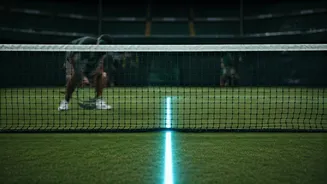
Wimbledon is making a pivotal technological leap, announcing the implementation of video review technology for line calls commencing with the 2026 tournament.
This strategic move positions Wimbledon alongside the Australian Open and the US Open, both of which have already embraced similar systems. The All England Club has confirmed that Hawk-Eye Live, a system capable of making automated line calls, will be fully operational on every court during the Grand Slam. This transition signifies a notable departure from Wimbledon's historically gradual adoption of new technologies, occurring after thorough testing and valuable input from both players and officials. The integration of Hawk-Eye Live is expected to eliminate the need for human line judges for line calls, providing immediate and precise rulings, thereby accelerating the pace of matches and reducing player challenges.
Technological Evolution
The adoption of automated line-calling technology by Wimbledon marks a significant evolution in how tennis matches are officiated. This move follows the precedent set by the Australian Open in 2021 and the US Open in 2023, ensuring that all four Grand Slam tournaments will feature this advanced system by 2026. Interestingly, Wimbledon had already taken a step towards modernization in the previous year by removing line judges after 176 years and introducing an Electronic Line Calling (ELC) system. However, this initial transition wasn't without its difficulties. Notable players like Emma Raducanu and Jack Draper voiced concerns about the accuracy of the ELC, with Raducanu attributing some of her losses to incorrect calls. A particularly dramatic incident involved Anastasia Pavlyuchenkova, who felt a crucial point was unjustly affected by the ELC's failure to register a fault, highlighting the challenges and complexities that can arise with nascent technology.
Player Challenges
Video Review Technology (VRT), already a fixture at two Grand Slams and various top-tier professional tours, will now be available on six Wimbledon courts starting in 2026, empowering players to contest specific decisions made by the chair umpire. This system allows for an unlimited number of reviews per player. Centre Court and Court No. 1 will benefit from VRT throughout the entire tournament, while Courts No. 2, 3, 12, and 18 will have it available for singles matches until their conclusion. The types of calls eligible for review include 'not-up' (a ball bouncing twice before being returned), whether a player or racket has touched the net during play, and 'hindrance' calls. Wimbledon's official statement clarifies that players can initiate reviews for calls that end a point, or those made immediately after a point concludes, such as hindrance calls. These reviews can either confirm or overturn the umpire's original decision, offering a crucial layer of dispute resolution.
Hindrance Call Nuances
The introduction of VRT for hindrance calls at Wimbledon brings with it a unique set of complexities, as was vividly illustrated by Jack Draper's experience at Indian Wells. In a match where the score was 6-1, 5-5 in Daniil Medvedev's favor, Draper made a shot and then, in a moment of frustration, raised his hands, believing the ball had landed out. However, the rally continued for three more shots before Draper secured the point. Medvedev then appealed to the chair umpire for a 'hindrance' call, which was awarded in his favor. This instance highlighted a potential pitfall of VRT: it can become outcome-dependent. Had Medvedev won the point directly, he might not have pursued the hindrance call. This scenario raises questions about the fairness of the electronic system, suggesting that even advanced technology can introduce new avenues for perceived errors and disputes, complicating the quest for perfect officiating.
French Open's Stance
Amidst the global shift towards advanced officiating technology in tennis, the French Open remains a notable exception. As the last remaining Grand Slam tournament, Roland Garros continues to rely on human line judges and has yet to implement video review technology. Reports from BBC Sport indicate that the French Tennis Federation's (FFT) reluctance stems from a deep-seated tradition, having utilized this human-centric system for 134 years. Furthermore, there appears to be a deliberate unwillingness to relinquish human control in the officiating process. Gilles Moretton, president of the FFT, has publicly stated his support for retaining referees and line judges, expressing a hope that this traditional approach can be maintained in their tournaments for the foreseeable future, positioning the French Open as a bastion of conventional umpiring in an increasingly digitized sport.