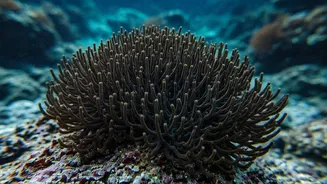

Deep-Sea Discovery
The discovery of a 300-year-old giant black coral in the deep waters of New Zealand unveils a captivating narrative of slow growth and hidden ocean mysteries.
These corals, which are not black in their live form, but rather appear pale or white, provide scientists with a unique opportunity to study historical oceanic conditions. This finding emphasizes the need for enhanced protection measures to ensure the preservation of these fragile species and the ecosystems they inhabit. The New Zealand Marine Protected Areas Policy offers partial protection, however, effective enforcement, comprehensive habitat mapping, and continuous monitoring are vital to the conservation of black corals. Scientists are also calling on divers and local operators to report any sightings of black corals exceeding four meters to help in the compilation of accurate distribution data.
Identifying Black Corals
Black corals, despite their name, often appear pale or white in their living state, making identification challenging. This camouflage requires meticulous observation, often involving microscopic examination or DNA sequencing, particularly in regions where various coral species coexist. In New Zealand, the Wildlife Act 1953 offers legal protection to these corals, making it an offense to damage, take, or possess them. Surveillance by conservation authorities and reporting by the community help in enforcement. This proactive approach supports the conservation of these ancient and important organisms. These identification challenges highlight the importance of careful observation and advanced scientific techniques in marine research.
Scientific Significance
Black corals have an impressive lifespan, serving as biological time capsules that hold valuable information about past oceanic conditions. This unique characteristic is particularly crucial for scientists studying paleoclimatology, allowing them to analyze historical temperature and current levels. These corals offer a window into the past, helping scientists understand the impacts of climate change and other environmental factors on marine ecosystems. Their longevity and ability to record environmental data make them essential for understanding long-term ecological trends and the impacts of climate change. This data helps researchers reconstruct past oceanic events and gain a better grasp of the planet's history.
Ecological Role
Black corals play a crucial role in marine ecosystems, contributing to biodiversity and providing habitats for various marine species. These corals create complex structures that serve as shelter, breeding grounds, and feeding areas for numerous organisms. The intricate architecture of black coral colonies supports a diverse range of marine life, demonstrating their importance to the overall health and stability of the marine environment. Their presence contributes to the richness and complexity of these underwater habitats, highlighting the interconnectedness of marine life and the importance of conservation efforts. The ecological role of black corals shows that the protection of these species is very important to keeping a healthy marine ecosystem.
Conservation Efforts
Ongoing conservation efforts in Fiordland are vital to safeguard the future of black corals. The New Zealand Marine Protected Areas Policy provides partial protection, focusing on biodiversity in multiple ecosystems. However, researchers are urging for stronger protection. They suggest enhanced enforcement, consistent monitoring, and detailed habitat mapping to boost preservation. Targeted surveys by researchers from Victoria University, along with the Department of Conservation and Fiordland Marine Guardians, are being implemented to identify ecologically important areas. Encouraging divers and local operators to report sightings of black corals larger than four meters helps gather distribution data and assess colony abundance. These multifaceted actions are essential for the long-term survival of black corals and the ecosystems they support.