





A New Era of Access
The landscape of pilgrimage to the sacred Haji Malang Dargah and historic Malanggad Fort has been dramatically reshaped with the advent of the Shri Malanggad Funicular
Railway. Located near Kalyan in Maharashtra, this innovative transport system, which began operations in early 2026, redefines accessibility for devotees. Previously, ascending to these revered sites involved a formidable climb of over 2,500 stone steps, a journey that could take as long as two hours and posed significant challenges, particularly for the elderly and those with mobility issues. The funicular now completes this ascent in a mere ten minutes, offering a smooth, consistent, and comfortable ride. This transformation makes the spiritual journey significantly more approachable, allowing a wider range of people to experience the cultural and religious significance of these locations without the physical strain of the arduous climb. The impact on the pilgrim experience is profound, turning a daunting physical challenge into an effortless transition.
Engineering on Steep Slopes
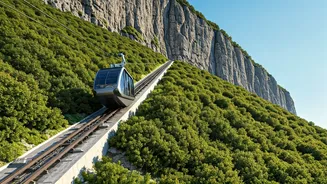
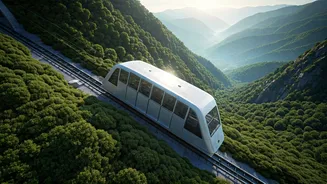
At its core, the Shri Malanggad Funicular Railway is a sophisticated engineering solution for navigating extreme inclines. This type of railway is specifically designed for transporting passengers up and down steep gradients, utilizing a unique counterbalancing technique. Instead of conventional engines pulling carriages, a funicular employs two connected cars that move along a track. These cars are linked by a robust cable that runs over a pulley system situated at the highest point of the track. The ingenious design ensures that as one car ascends the slope, the other car descends simultaneously. This reciprocal motion allows the weight of the descending car to assist in pulling the ascending car, significantly reducing the energy required for operation. This self-balancing mechanism is crucial for efficient movement on the challenging 33-degree incline of the Shri Malanggad track, which spans a little over a kilometre.
A Monumental Undertaking
The conception and realization of the Shri Malanggad Funicular Railway represent a decade-long commitment, first envisioned around 2006. The primary objective was to alleviate the difficulties faced by visitors attempting to reach the religious and historical sites. Engineers grappled with the inherent complexities of the mountain terrain and the exceptionally steep gradients, which presented substantial obstacles. The initial cost projections for the project were estimated at approximately Rs 90 crores. The construction itself was a formidable task, primarily due to the nature of the local geology. The hills surrounding Malanggad are composed of hard basalt rock, necessitating meticulous planning and considerable effort for excavation. Furthermore, the operational space on the slopes was often limited, restricting the deployment of heavy machinery. Adding to these challenges, the region's typical monsoon season frequently disrupted work, as heavy rainfall rendered the slopes unstable and unsafe for construction activities. These persistent environmental and logistical hurdles contributed significantly to the project's extended timeline.
Capacity and Ride Experience
The operational capabilities of the Shri Malanggad Funicular Railway are designed to accommodate a substantial number of passengers efficiently. Each ride can typically carry between 90 to 120 individuals, ensuring that a significant flow of pilgrims and tourists can reach the summit without prolonged waiting times. The visual spectacle of the trains traversing the elevated tracks is striking, but it's the underlying principle of their operation that is truly fascinating. The twin-coach system, linked by a single cable, operates on the principle of counter-balance. As one coach begins its upward journey, the other starts its descent, effectively leveraging their combined weight for propulsion. This elegant mechanical solution minimizes the reliance on external power sources, making the system both energy-efficient and reliable. For visitors, the difference in travel experience is immediately apparent. The arduous climb, which once demanded considerable physical exertion, is now a pleasant ten-minute ride. This enhanced accessibility is particularly beneficial for older pilgrims who found the traditional steps overwhelming, and for families with young children, who can now enjoy the journey together as a manageable and even enjoyable experience.