






Trade Deal Triggers Rally
The Indian stock market experienced an unprecedented surge, with both the BSE Sensex and Nifty 50 registering substantial gains. This powerful upward movement
was directly attributed to the announcement of a long-awaited trade agreement between India and the United States. The deal effectively dissolved months of tariff-related uncertainty, which had previously dampened investor confidence and discouraged foreign capital. The benchmark BSE Sensex soared by over 4,200 points, reaching an intraday peak of 85,871.73, marking a 5.1% increase. Similarly, the Nifty 50 climbed an impressive 1,252 points, or 5%, hitting 26,341.2 during trading hours. While some of these gains were moderated by the session's close, the market still ended significantly higher, with the Sensex up 2.54% and the Nifty 50 up 2.51%. This broad-based optimism also extended to smaller cap stocks, with Nifty Smallcap and Nifty Midcap indices climbing approximately 3%.
Investor Wealth Skyrockets
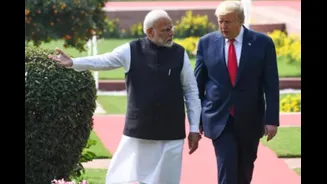
The significant market upturn following the India-US trade deal resulted in a colossal increase in investor wealth. The total market capitalization of companies listed on the BSE swelled by more than ₹12.5 lakh crore in a single trading day, moving from ₹455 lakh crore to ₹467.35 lakh crore. This impressive gain underscores the positive sentiment generated by the agreement, which saw participation broaden across various market sectors. The core catalyst for this surge was the mutual resolution of trade disputes. U.S. President Donald Trump confirmed a reduction in reciprocal tariffs on Indian goods from 50% to 18%. In a reciprocal move, India committed to substantially decreasing both tariff and non-tariff barriers on American products, aiming for zero. This reciprocal tariff reduction, from 25% to 18% for the US and a move towards zero for India, signals a new era of trade cooperation and market accessibility.
Market Sentiment Shifts
The trade pact has fundamentally altered the market's outlook, removing a significant cloud of uncertainty that had loomed for months. Investors perceived this agreement as a crucial step towards re-establishing trade stability, enhancing export competitiveness for India, and reinforcing its standing within global supply chains. Market strategists believe this development is poised to decisively shift sentiment, prompt short-covering activities in derivatives, and attract foreign investment back into well-established, fairly valued large-cap companies. The confluence of positive market sentiment, strategic positioning, and favorable global capital flows creates a supportive environment for investors. This agreement is seen as a key driver that could invigorate the economy and boost investor confidence, paving the way for sustained market growth.
Investment Opportunities Emerge
The positive repercussions of the India-US trade deal are expected to benefit several key sectors. Analysts are highlighting banking and non-banking financial companies, telecom giants, capital goods manufacturers, and the IT sector as potential beneficiaries of this renewed economic optimism. Furthermore, the textiles industry is also being closely watched due to improved trade linkages resulting from the agreement. The immediate implication for investors is a likely leadership shift towards quality large-cap stocks, which are well-positioned to absorb returning foreign capital. As momentum builds, it is anticipated to spread into mid-cap and small-cap segments. This strategic shift suggests a preference for fundamentally strong companies that can capitalize on the enhanced trade environment and a more stable economic outlook.
Technical Factors Aid Rally
Beyond the fundamental improvements brought by the trade deal, technical factors are also playing a significant role in amplifying the current market rally. The Indian market had a considerable base of short positions prior to the news. When positive developments occur in an oversold and heavily shorted market, the initial upward movement can trigger a cascade of short-covering, where traders are compelled to buy back positions to limit losses. This process dramatically accelerates gains, often exceeding what might be explained by fundamentals alone in the short term. This dynamic is particularly evident in high-beta derivative segments where positioning is often concentrated. The combination of a positive surprise, technical short-covering, and expected foreign institutional investor (FII) inflows is creating a powerful upward force, making large-cap stocks with fair valuations particularly attractive for outperformance.