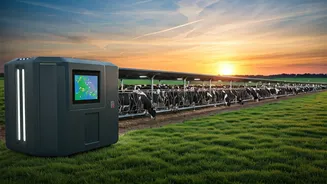








The Future of Herding
The traditional dairy farm, often beginning before dawn, is undergoing a radical transformation thanks to innovative technology. In the past, a farmer
might spend up to forty-five minutes rounding up hundreds of cows scattered across paddocks, a process that typically involved manual effort, dogs, and physical barriers. This laborious routine is rapidly becoming obsolete. With a simple tap on a smartphone, a new breed of farm allows for the automated movement of an entire herd. Each animal is equipped with a small device that, when prompted, guides them towards their destination, such as the milking shed. This system, developed by Halter, represents a paradigm shift, eliminating the need for constant human intervention and physical fencing, a development that has captured significant investor attention, leading to a remarkable $2 billion valuation.
Virtual Boundaries, Real Control
Halter revolutionizes farm management by replacing costly and high-maintenance physical fences with a sophisticated virtual system. Farmers can delineate grazing areas or direct their herds using a smartphone app, drawing boundaries on a satellite map that are then translated into GPS coordinates. These coordinates are instantly transmitted to collars worn by each cow. Each collar continuously tracks an animal's location multiple times per minute. When a cow nears a virtual boundary, the collar emits a subtle sound on one side of her neck. Through a process akin to classical conditioning, cows learn to associate this sound with the need to turn away from the boundary, effectively self-regulating their movement. This technology eliminates the significant expenses associated with physical fencing, which can range from $15,000 to $40,000 per mile, and reduces the need for daily herding labor.
The Pavlovian Herd
The ingenious core of Halter's system lies not in complex electronics but in the principles of behavioral science, effectively training cows through associative learning. When a farm first adopts Halter, an initial onboarding period, typically spanning about a week, is crucial. During this phase, farmers actively guide their herds, with the collars emitting sound cues that reinforce desired movements. Each time a cow responds correctly by moving in the intended direction, the sound ceases, reinforcing the positive association. This gradual process leads to the cows internalizing the cues, rendering physical guidance unnecessary within days. Given their naturally social disposition, once a few cows respond to the signals, the rest of the herd follows suit, creating a self-managing and collectively learning unit. This allows hundreds of animals to be trained to respond reliably to algorithmic prompts without continuous direct human supervision.
The Cowgorithm's Insight
Beyond guiding movement, the sophisticated collar continuously gathers vital data on each individual cow, creating a comprehensive behavioral profile. This includes metrics such as chewing patterns, body temperature, activity levels, and indicators of fertility. Halter's proprietary AI, affectionately termed the 'Cowgorithm,' has been trained on extensive datasets from hundreds of thousands of cows over several years, enabling it to understand what constitutes normal behavior for each animal. The system is designed to detect subtle deviations, such as reduced chewing or altered movement, which can signal illness up to 24 to 48 hours before visible symptoms manifest. This early detection capability is invaluable for reducing treatment costs and improving animal welfare. Furthermore, the system excels at identifying fertility windows, which are critical for herd reproductive efficiency. By recognizing behavioral shifts associated with these fertile periods, the AI alerts farmers precisely when artificial insemination or natural mating would be most effective, preventing costly delays in breeding cycles.
Economic Impact and Growth
The widespread adoption of Halter's virtual fencing technology is yielding substantial economic benefits. Across the United States alone, users have implemented over 11,000 miles of virtual boundaries, a figure comparable to the perimeter of the continental United States, leading to estimated savings of $220 million in physical fencing costs. The system is currently operational on more than 700,000 cattle across New Zealand, Australia, and 22 states in the US. Halter operates on a recurring revenue model, charging between $5 and $8 per cow monthly for the service, with collars being leased rather than sold. For a farm with 500 cows, this typically amounts to approximately $3,000 per month, with larger operations incurring higher costs. Once a farm integrates its operations around this digital infrastructure, transitioning away becomes challenging due to the deep reliance on the system.
A Billion-Dollar Vision
The significant backing from prominent investors like Peter Thiel's Founders Fund underscores the transformative potential recognized in Halter. The fund has been a consistent supporter since the company's early development phase in 2018. The recent valuation of approximately $2 billion, with Founders Fund leading a new funding round, is a testament to the company's proven growth and its ability to manage hundreds of thousands of animals effectively. This substantial investment reflects strong confidence in both the underlying technology and its long-term viability and scalability, positioning Halter as a major player in the future of agriculture and beyond.
Beyond the Farm Gate
While Halter's immediate impact is revolutionizing agriculture, its core innovation possesses implications far beyond the dairy industry. At its heart, the company has developed a sophisticated system capable of orchestrating thousands of living entities in real-time through data, sensors, and behavioral cues. The principles guiding this animal coordination could be adapted for applications such as managing wildlife populations, optimizing logistical operations, or even enhancing robotic swarm behaviors. More broadly, this technology signifies a fundamental shift in how physical environments are managed, enabling software systems to autonomously guide and optimize tasks that previously demanded continuous human oversight. In an era facing increasing labor shortages and the demand for greater efficiency, solutions like Halter offer a glimpse into a future where technology alleviates the burdens of physically demanding work and enhances productivity across various sectors.