




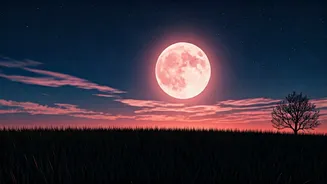
The Pink Full Moon
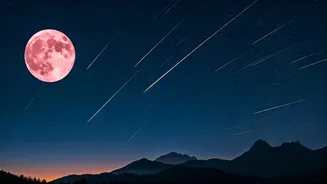
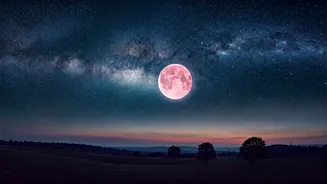
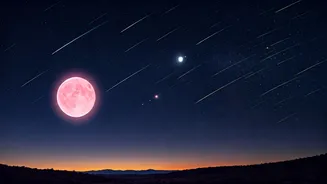
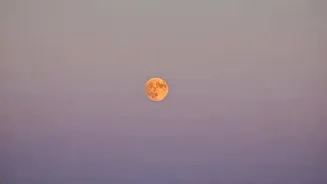
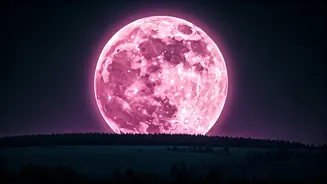
On April 1st, 2026, at 10:12 PM ET, the sky will host the first full moon of spring, famously known as the Pink Moon. This naming doesn't refer to its
color but rather its timing, coinciding with the blooming of moss pink flowers across North America. Adding to its splendor, this full moon will occur when it's closest to Earth, resulting in a supermoon effect. This proximity will make the moon appear approximately 15% brighter and slightly larger than usual, offering a particularly captivating visual experience for observers. It's a perfect opportunity to appreciate the subtle beauty of our natural satellite enhanced by its orbital mechanics.
Mercury's Morning Display
Mark your calendars for April 3rd, 2026, as Mercury achieves its greatest western elongation. This astronomical event positions the planet at its furthest point from the Sun as seen from Earth, making it significantly easier to spot in the pre-dawn sky. Typically challenging to observe due to its proximity to the Sun's glare, Mercury will be visible low on the eastern horizon before sunrise. This extended visibility is invaluable for astronomers, providing a clearer window to study the planet's surface features and its tenuous atmosphere, offering rare insights into this elusive celestial body.
Comet C/2026 A1
An exciting celestial visitor, Comet C/2026 A1 (MAPS), will make a close approach to the Sun on April 4th, 2026. This 'sun-grazing' comet will pass astonishingly near our star, about 850,000 miles away. The intense solar heat will cause the comet's icy core to vaporize, generating a brilliant, glowing coma and a spectacular tail that could stretch across the sky. If the comet maintains its structural integrity during this close encounter, it has the potential to evolve into a 'Great Comet,' a rare and breathtaking spectacle visible to the naked eye in the morning sky, a truly remarkable sight for humanity.
Pre-Dawn Planet Parade
From April 16th to April 23rd, 2026, observers are treated to a remarkable planetary alignment. Mercury, Mars, Saturn, and Neptune will cluster together in the sky, creating a stunning pre-dawn display. While they will appear incredibly close to each other from our perspective on Earth, it's important to remember they remain millions of miles apart in the vastness of space. Such rare celestial gatherings offer astronomers unique opportunities for studying the dynamics of our solar system and for calibrating sensitive telescopic equipment, enhancing our understanding of planetary orbits and interactions.
Moon, Venus, Pleiades
The nights of April 18th and 19th, 2026, promise a visually striking conjunction. The Moon, the brilliant planet Venus, and the enchanting Pleiades star cluster will appear in close proximity, creating a picturesque celestial tableau. This kind of alignment is a delight for amateur stargazers, offering a beautiful vista easily appreciated with the naked eye or binoculars. For astronomers, these conjunctions also serve as valuable points of reference for tracking the intricate movements of planets and stars across the night sky, aiding in the ongoing study of celestial mechanics.
Lyrid Meteor Shower Peak
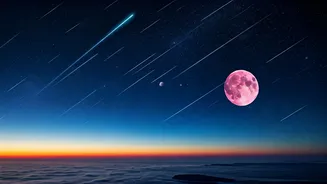
The annual Lyrid meteor shower will reach its peak activity on April 22nd and 23rd, 2026. This shower originates from dust and debris left behind by Comet Thatcher. As Earth navigates through this celestial trail, tiny particles enter our atmosphere at breakneck speeds of approximately 110,000 mph, burning up and producing brilliant streaks of light. With a history of observation spanning over 2,700 years, the Lyrids are among the oldest documented meteor showers, offering a chance to connect with a phenomenon witnessed by ancient civilizations.
Whirlpool Galaxy Views
Throughout April 2026, the magnificent Whirlpool Galaxy, also cataloged as Messier 51, will be optimally positioned for observation. Located about 31 million light-years away, this spiral galaxy is currently engaged in a gravitational dance with a smaller companion galaxy, NGC 5195. This interaction makes the Whirlpool Galaxy an exceptional target for astronomers aiming to study the processes of star formation within the intricate spiral arms of galaxies. Its visual grandeur and scientific importance make it a highlight of the month's astronomical offerings.
Aurora Season Fades
As April 2026 draws to a close, the vibrant displays of the Northern Lights will begin to recede in the Northern Hemisphere. The increasing daylight hours characteristic of late spring gradually overpower the darkness required for optimal aurora viewing. While the underlying solar activity that fuels these breathtaking auroras continues, the bright skies will render them increasingly difficult to perceive. This period signifies the traditional end of the aurora season in the Arctic regions, making the earlier parts of the month the prime time for any last chances to witness this natural wonder.