





Antarctica's Lambert
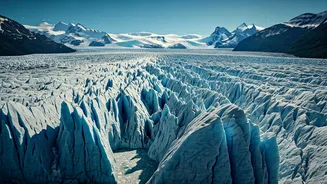
Dominating the icy landscape of East Antarctica, the Lambert Glacier stands as the undisputed champion of glacial size. This colossal ice stream is a true
marvel, stretching an astounding 400 kilometers (250 miles) in length and commanding a drainage area that accounts for approximately 8% of the entire Antarctic ice sheet, feeding directly into the Amery Ice Shelf. In some stretches, its width surpasses a remarkable 100 kilometers, making it the largest not only in terms of sheer length but also in its immense volume. Its existence shapes vast swathes of the continent, a testament to the immense forces of nature at play in the planet's most frigid regions. The sheer scale of Lambert Glacier is difficult to comprehend, a frozen river of ice so vast it dwarfs many countries, a powerful reminder of Earth's ancient geological processes and its capacity for colossal natural formations.
Seller Glacier's Might
On the western edge of the Antarctic Peninsula lies the Seller Glacier, another behemoth contributing to the continent's glacial dominance. Recognized as one of the world's largest individual glaciers, it sprawls across an area exceeding 7,000 square kilometers. This immense ice body is renowned for its production of significant tabular icebergs, colossal ice formations that break off and drift into the Southern Ocean. The recent history of Seller Glacier is marked by rapid retreat, a phenomenon that has accelerated in recent decades, particularly following the dramatic collapse of the adjacent Wordie Ice Shelf. This retreat highlights the glacier's sensitivity to changing climatic conditions and its role as an indicator of broader environmental shifts occurring in the polar regions, underscoring the interconnectedness of glacial systems and atmospheric warming.
Antarctic Peninsula Ice Sheet
The Antarctic Peninsula Ice Sheet (APIS) represents a vast and crucial glacial system, covering an expansive area of approximately 522,000 square kilometers. Its geographical position, relatively far north within the Antarctic region, makes it particularly susceptible to the escalating impacts of climate change, especially given the rapid warming trend observed in this specific area. The ice sheet encompasses nearly 80% of the Antarctic Peninsula and boasts an average thickness of around 500 meters. Alarmingly, the APIS is currently experiencing substantial mass loss, with a significant majority of its glaciers, around 87%, documented as undergoing retreat. This widespread melting signals a critical juncture for the region's ice reserves and has profound implications for global sea levels and regional ecosystems.
Alaska's Malaspina-Seward
Venturing to Alaska, we encounter the Malaspina-Seward Glacier system, a spectacular example of a piedmont glacier. The Malaspina Glacier itself is the world's largest of its kind, a sprawling expanse covering between 3,900 and 4,350 square kilometers in the southeastern part of Alaska's Wrangell-St. Elias National Park. This massive, fan-shaped lobe receives its ice flow primarily from the Seward Glacier, which acts as the crucial icefield source, channeling immense volumes of ice down from the towering mountains. Notably, the Malaspina Glacier contains, albeit diminishing, significant areas of supra-glacial forest, patches of vegetation that have managed to establish themselves on the ice surface, adding a unique ecological dimension to this frozen landscape. The interaction between ice, land, and vegetation here offers a fascinating glimpse into glacial dynamics.
Thurston Island's Giant
Off the coast of mainland Antarctica lies Thurston Island, home to the imposing Thurston Island Glacier No. 1. This impressive glacial formation spans an area of approximately 5,261 square kilometers. Like many of its Antarctic counterparts, this glacier remains perpetually encased in snow and ice, enduring year-round frigid conditions. Its substantial size makes it one of the most prominent and significant glaciers among the numerous islands dotting the surrounding Antarctic region. The sheer scale and isolation of Thurston Island Glacier No. 1 contribute to its mystique and underscore the vast, largely unexplored icy wilderness that characterizes this part of the continent. It stands as a testament to the enduring power and scale of ice in polar environments.
Alexander Island's Expanse
Alexander Island, the largest island in Antarctica, hosts another colossal ice feature: Alexander Island Glacier No. 1. This extensive glacier covers an impressive area of approximately 4,766 square kilometers. The region is characterized by its vast, thick ice sheets and an extreme degree of remoteness, making it one of the planet's least accessible areas. Alexander Island Glacier No. 1 is recognized as one of the two major glaciers situated on this significant Antarctic island. Its immense presence contributes to the overall glacial mass of the island and serves as a key component of the Antarctic ice cover, reflecting the continent's role as the world's largest repository of freshwater ice. Its existence highlights the scale of ice accumulation in these polar latitudes.
Arctic's Wykeham South
Moving to the northern polar regions, Wykeham Glacier South in the Canadian Arctic commands attention with its considerable size. Spanning an area of approximately 3,176 square kilometers, it is situated within an environment defined by extreme cold and profound remoteness. This glacier plays a crucial role in the regional hydrological system, acting as a significant source of meltwater that feeds nearby rivers and lakes. Its vastness earns it recognition as one of the largest glaciers found outside the continent of Antarctica, demonstrating that significant glacial formations exist in both polar extremes. Wykeham Glacier South is a vital contributor to the Arctic's delicate ecological balance and its water cycles.