




Invisible Cosmic Downpour
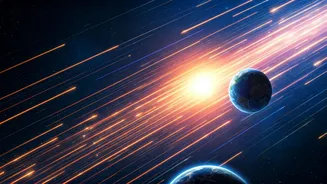
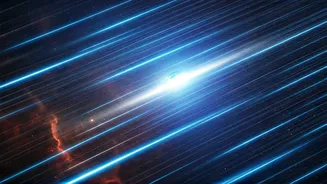
Imagine an invisible deluge, not of water, but of incredibly energetic particles, constantly showering our planet. These are galactic cosmic rays (GCRs),
a ceaseless torrent originating from the far reaches of our galaxy. They are not rays at all, but rather subatomic particles like protons and atomic nuclei, stripped bare and traveling at speeds astonishingly close to the speed of light. Each second, an estimated one such particle passes through the palm of your hand, an intimate yet unnoticed connection to the vastness of space. These particles, born from cataclysmic stellar events, carry immense energy, and when they encounter Earth's atmosphere, they trigger a cascade of secondary particles that continue the journey to the surface, like a cosmic confetti storm. Their existence has even inspired science fiction narratives, highlighting the profound connection between our everyday reality and the energetic processes of the cosmos.
Discovery in the Stratosphere
The revelation of galactic cosmic rays was an accidental triumph, born from scientific curiosity and a daring ascent. In 1912, Austrian physicist Victor Hess embarked on a series of balloon flights, reaching altitudes of approximately 5,300 meters. His objective was to measure ionizing radiation, expecting it to diminish with height as he moved away from Earth's radioactive crust. However, his measurements yielded an unexpected result: radiation levels actually increased as he ascended. This anomaly, observed even during a partial solar eclipse which ruled out the Sun as the primary source, led Hess to a groundbreaking conclusion: the ionizing radiation was of extraterrestrial origin. This pioneering work, demonstrating that scientific inquiry often requires venturing into the unknown, earned him the Nobel Prize and fundamentally changed our understanding of the space environment.
Supernova Particle Factories
The majority of galactic cosmic rays, particularly those with lower energies, are believed to originate from the explosive deaths of massive stars. Supernova remnants, the expanding, incandescent clouds of debris left in the wake of these stellar explosions, act as powerful cosmic accelerators. Within these turbulent environments, intense magnetic fields trap charged particles, propelling them to higher and higher energies through a process akin to a cosmic game of pinball. Each collision and interaction within the remnant imbues these particles with more momentum. Astrophysicists liken these energetic particles to the 'exhaust' of supernovae, the most potent engines in our galaxy. Over billions of years, our Milky Way galaxy has accumulated a vast reservoir of this stellar debris, and Earth, along with everything on it, is continuously bathed in this ancient cosmic outflow.
Mysteries of Extreme Energies
The most energetic cosmic rays, however, present a profound enigma. These particles arrive with energies so extreme that, according to current physical models, they should have lost their power over vast interstellar distances due to interactions with the cosmic microwave background radiation. Their intact arrival suggests they must have originated from relatively nearby cosmic sources. Leading candidates for these ultra-high-energy cosmic rays include active galactic nuclei, which are supermassive black holes at the centers of other galaxies that are actively consuming surrounding matter, and gamma-ray bursts, among the most violent and luminous explosions known in the universe. The fact that these particles reach us with such immense energy challenges our understanding of particle acceleration and propagation across cosmic scales, pushing the boundaries of astrophysical research.
Cosmic Rays as Cosmic Detectives
A significant challenge in studying galactic cosmic rays stems from their charged nature. As these particles traverse the cosmos, they encounter pervasive magnetic fields, both within our galaxy and beyond. These fields act like invisible forces, bending and deflecting the particles' paths, scrambling their trajectories over immense distances. By the time they reach Earth, pinpointing their original source becomes an incredibly complex task, akin to a detective piecing together fragmented clues. Instead of simply tracing a particle's path backward, scientists must employ indirect methods and sophisticated analyses to infer the origins of these enigmatic messengers, relying on their energy, composition, and distribution patterns to unlock the secrets of their birthplaces.
Archaeological Insights and Astronaut Encounters
The omnipresent shower of cosmic rays offers remarkable practical applications and personal encounters with the universe's fundamental forces. In 2017, a technique known as cosmic ray muon tomography, which utilizes the secondary particles generated by cosmic ray collisions, was employed to scan Egypt's Great Pyramid of Giza. This non-invasive method, using particles far more penetrative than conventional X-rays, revealed a previously undiscovered void within the ancient monument, a hidden space that had remained concealed for millennia. Furthermore, astronauts in orbit, where Earth's protective atmosphere and magnetic field are significantly diminished, report experiencing visual phenomena such as flashes of light even with their eyes closed. This intriguing effect is caused by cosmic rays directly interacting with the retina, serving as a tangible, personal reminder that we are not merely observers of the universe, but are intimately immersed within its energetic embrace.