




The Final Moments
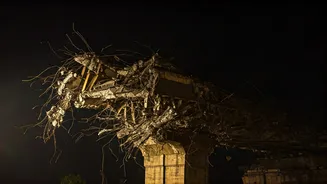
The culmination of over three months of planning and 58 nights of work arrived with the severing of a single, stubborn inch of steel. As dawn approached,
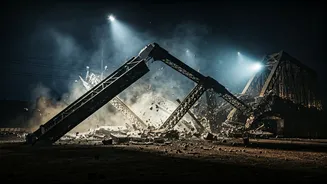
a lone welder worked on the 30,000-kilogram girder, the last link holding the 37-meter span to its pillar. With the sides already cut and crane ropes secured, the anticipation among the weary crew was palpable. After a final manual push with a crowbar, the massive girder swung free, met by a sky illuminated by pre-arranged fireworks, marking the end of a 112-year-old landmark’s physical presence. This dramatic moment was the endpoint of an extensive process that had begun long before, a testament to the meticulous planning and execution required for such a significant undertaking.
A Beloved Connector
For over a century, the Elphinstone Bridge was more than just a structure; it was an integral part of Mumbai's daily life, bridging the east and west sides of the city bisected by railway lines. Its strategic location near Prabhadevi and Parel stations made it a vital artery for thousands of commuters heading to and from shiny office buildings. The bridge's sturdy, fort-like basalt stone walls served as a backdrop for countless daily scenes of hurried footsteps, shared taxis, and animated conversations over cups of chai. However, as Mumbai evolved and its infrastructure demanded greater capacity and speed, the age-old bridge was destined to become a relic. Its closure in September 2025 symbolized a broader urban transformation, where the old was making way for the new – a vision of concrete and elevated roadways designed for seamless, rapid transit.
Engineering Hurdles Ahead
The bridge’s initial design, based on 1911 blueprints, presented natural divisions, allowing for a logical dismantling into 28 constituent parts, split across three sections with seven or eight panels each. However, two significant complications emerged that demanded ingenious solutions. Firstly, the bridge spanned 11 active railway tracks, necessitating work only within a tight, three-hour nocturnal window between the last and first trains, or during infrequent, disruptive city-halting blocks. This severely limited operational time. Secondly, decades of track elevation had caused the overhead electrical (OHE) wires powering the trains to creep upwards, becoming entangled with the bridge's structure at a mere 5.5-meter clearance. This entanglement posed a critical safety risk, requiring a novel approach to temporarily suspend the OHE wires during the demolition process.
Innovative Solutions Emerge
Anirudh Sharma, the project manager from MRIDC, devised a groundbreaking solution for the OHE wire entanglement problem, inspired by a clothesline. The concept involved a temporary beam placed across the girders to suspend the OHE wires, allowing panels to be safely removed from underneath. Western Railway eventually approved this innovative approach. The demolition process, however, was not without its setbacks. An initial attempt on New Year's Eve stalled, and another on January 3rd proved too ambitious, consuming valuable time in crane positioning and resident standoffs. Nevertheless, by January, a steady rhythm began to form, with nights dedicated to cutting panels free, leaving only the corners intact, until the critical night when the span over the Western Railway lines was successfully brought down, supported by the temporary OHE system.
The Central Railway Stalemate
As work progressed over the Western Railway tracks, the dismantling of the bridge section above Central Railway (CR) tracks encountered a significant deadlock. Despite the successful implementation of the temporary OHE arrangement on the Western Railway side, CR officials refused to grant approval, citing safety concerns and demanding longer block times for OHE management, nearly doubling the time taken on WR tracks. This created mounting costs, with an 800-metric-ton crane incurring rent of approximately Rs 80 lakh per month while remaining idle. Negotiations became protracted, with dozens of official and unofficial discussions. Faced with escalating expenses and little progress, the contractors initially decided to withdraw the crane. However, intervention from MRIDC’s managing director, who facilitated a meeting with CR officials, eventually led to a shift in stance, allowing work to resume.
Triumphant Completion
Following the breakthrough with Central Railway, the demolition team moved with renewed urgency. Although a crane operator’s accident delayed one planned night, work quickly gained momentum once operations resumed. The final, crucial megablock was scheduled for the night of April 4th. As the last train departed and power was cut, the team was ready. The previous challenges had honed their coordination into a precise choreography. By just after 6 am on April 5th, the final girder was successfully detached and swung free, triggering a spontaneous celebration of fireworks. The sight of the empty sky where the 112-year-old bridge once stood was a powerful testament to the resilience and ingenuity that overcame significant obstacles to achieve this monumental feat.