




A Hidden River Network
While India is renowned for its mighty rivers like the Ganga and Yamuna, a lesser-known fact often stumps even knowledgeable individuals during general
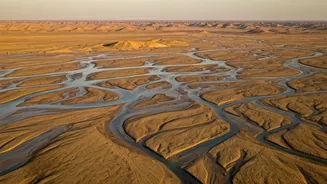
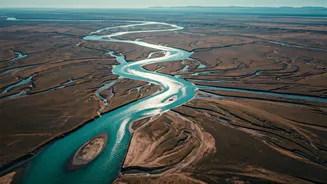
knowledge challenges. This surprising revelation centers on Gujarat's Kutch district, a place that harbors an incredible count of approximately 97 rivers. This remarkable number positions Kutch as an exceptionally unusual riverine landscape within the country. These numerous waterways carve their paths through the district, ultimately either making their way to the Arabian Sea or gracefully disappearing into the expansive Rann of Kutch, forming an intricate and distinctive natural drainage system that is a testament to nature's resilience, even amidst arid conditions.
Desert's Dynamic Waterways
Contrary to the stark desert imagery typically associated with Kutch, the district showcases nature's remarkable ability to sustain a complex system of river channels. These rivers, though largely seasonal, come alive with vigor during the monsoon months. Statistics indicate that out of the nearly 185 rivers that traverse Gujarat, a significant proportion, around 97, are intrinsically linked to the Kutch region. This highlights a fascinating duality: a land known for its salt desert also possesses a dynamic network of flowing water, demonstrating that even in challenging climatic zones, water finds a way to shape the landscape and sustain life.
Seasonal Flow and Key Rivers
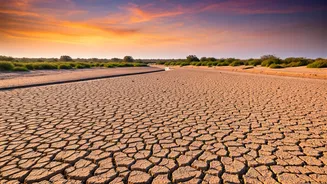
The rivers of Kutch are characterized by their ephemeral nature; most are not perennial and flow robustly only during the monsoon. Once the rains cease, they often recede into dry beds for the remainder of the year. Among the notable rivers that grace Kutch are Rukmavati, Suvi, Malan, Saran, Sakar, Mithi, Ghurud, Vekhdi, Chang, Khari, Nara, Panjora, Kharod, Kotri, Kali, Kanakavti, and Rudramata. Beyond these, numerous smaller streams emerge with the rainfall, only to vanish as the season progresses. The destination for many of these rivers is either the Arabian Sea or the vast Rann of Kutch, contributing to a unique hydrological pattern.
Drainage System Dynamics
The broader drainage system encompassing Kutch includes a significant number of rivers that either empty directly into the Arabian Sea or terminate within the immense salt expanse of the Rann. Prominent rivers contributing to this network are Banas, Saraswati, Rupen, Luni, Machhu, Ghodadhroi, Brahmani, Khari, Phalki, Nara, Suvi, Pur, and Bhurud. A defining characteristic of Kutch's riverine ecosystem is this seasonal behavior; their active flow is confined to the monsoon period. Furthermore, in several locales, the water can develop a saline quality, which consequently restricts its utility for everyday human needs, underscoring the environmental challenges of the region.
Nature's Resilience in Aridity
Despite the prevailing dry climate and desert conditions that define much of its geography, Kutch serves as a compelling example of nature's ingenuity. It illustrates how multiple channels for water flow can be established and sustained even in regions facing significant environmental challenges. The district's distinction lies not solely in its geographical features but also in this extraordinary and enigmatic river network, which continues to capture the imagination and spark curiosity among those who learn about its existence.