




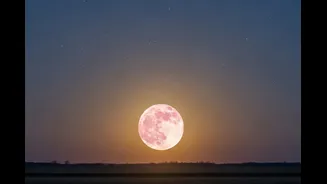
The Pink Moon's Name
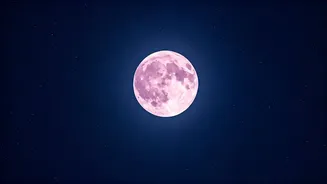
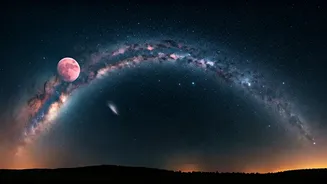
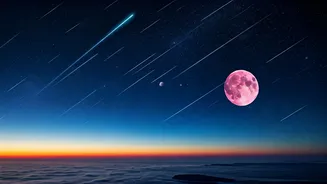
The celestial event known as the 'Pink Moon' is set to grace the night sky on April 1, 2026. This traditional name, however, doesn't signify a change in the Moon's
actual color. Instead, it originates from the Algonquin tribes of North America, who used the name to mark the blooming of a particular spring flower, moss pink (Phlox subulata). This early-blooming herb signals the arrival of spring in the Northern Hemisphere. The name has since been adopted and documented in publications like the Old Farmer's Almanack, linking the lunar cycle to seasonal changes in nature. While the visual spectacle doesn't involve a pink hue, it offers a unique opportunity for astronomical observation and a connection to ancient natural calendars.
Enhanced Brightness Explained
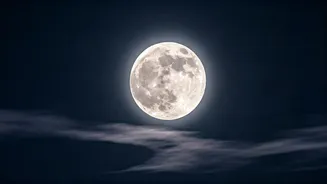
The 'Pink Moon' of April 2026 will appear unusually bright due to several astronomical factors. When the Moon reaches its full phase, it aligns directly opposite the Sun from Earth's perspective, a configuration known as syzygy. This positioning allows the Sun's light to fully illuminate the lunar face visible to us. Compounding this, the Moon is often near its furthest orbital point from the Sun during this phase. NASA highlights that this particular full moon's proximity to the vernal equinox influences its tilt, affecting how sunlight reflects off its surface. Furthermore, an 'opposition surge' occurs, where crater shadows are minimized from our viewing angle, making the Moon seem significantly more luminous than at other times.
Atmospheric Color Effects
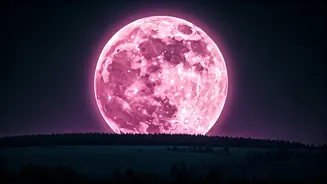
While the 'Pink Moon' is a misnomer regarding its actual color, atmospheric conditions can indeed lend the Moon a pinkish or reddish tint. This phenomenon occurs when the Moon is low on the horizon. Light from the Moon must travel through a much thicker layer of Earth's atmosphere before reaching our eyes. This extended journey causes shorter wavelengths of light, like blue and violet, to be scattered away by atmospheric particles. The longer wavelengths, specifically reds and pinks, are less affected and therefore penetrate through to our vision, giving the Moon a noticeable color shift. This atmospheric scattering is similar to why sunrises and sunsets often appear red.
Tides and Lunar Libration
The full 'Pink Moon' in 2026 occurs relatively close to perigee, the point in the Moon's orbit where it's closest to Earth. This proximity, termed a 'perigean full moon,' amplifies the Moon's gravitational pull on Earth's oceans, leading to higher tidal ranges. However, the most extreme 'King Tides' are anticipated later in the month, during the new moon phase, due to the combined gravitational forces of both the Moon and the Sun. Beyond tidal influences, this period offers a chance to observe lunar libration. Due to the Moon's slightly elliptical and tilted orbit, it exhibits a subtle 'nodding' and 'swaying' motion. This libration allows astronomers to see a larger portion of the lunar surface, approximately 59% in the first week of April, revealing features on its far eastern limb that are usually hidden from view.
The Opposition Effect
The full phase of the Moon, including the 'Pink Moon,' presents a unique visual characteristic known as the Opposition Effect, or Seeliger Effect. This occurs when the Moon is positioned directly opposite the Sun, resulting in a phase angle of zero degrees. At this alignment, the Sun's light strikes the lunar surface perpendicularly. Consequently, any shadows cast by craters and surface irregularities are largely eliminated from our line of sight. This absence of shadows significantly boosts the overall brightness of the Moon, making it appear more luminous. However, this same effect can diminish the perception of surface topography, causing features like lunar highlands to appear very bright and somewhat uniform, as shadows are essential for perceiving depth and texture.
Viewing the Pink Moon
The astronomical moment of the full 'Pink Moon' in 2026, signifying 100% illumination, will occur precisely at 02:12 UTC on April 2nd. For observers in the United States, this precise peak illumination will be visible on the evening of April 1st, at 10:12 PM Eastern Time. While this is the exact moment of fullness, the Moon will maintain a visually full appearance for approximately a full day before and after this peak. This extended period of fullness means that optimal viewing opportunities are not limited to a single moment, allowing ample time for skywatchers to appreciate the event.