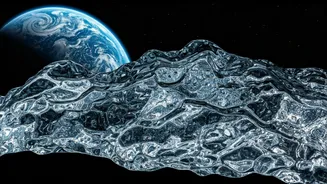

Lunar Water Hunt
NASA's focus on the Moon is not just about exploring a celestial body; it's a quest to understand Earth's water. Scientists believe studying lunar water ice
could provide critical information about how water came to be on our planet. They plan to analyze the composition and distribution of water molecules found on the Moon, which will hopefully unveil clues about the origins of Earth's water. This endeavor builds upon the work of past missions, expanding the scope of research into the geological and environmental conditions of both Earth and its celestial companion. Studying the lunar water ice could shed light on whether Earth's water came from asteroids or comets during the early stages of the solar system. The knowledge could lead to a deeper understanding of our planet's habitability and the potential for life beyond Earth. Exploring the Moon’s resources also offers potential for future space exploration, including the possibility of establishing a permanent lunar base, making the Moon a vital research center.
Moon's Water Reserves
The existence of water on the Moon, primarily in the form of ice, has been established by previous space missions. This discovery, particularly within permanently shadowed craters at the lunar poles, opened a new chapter for space exploration. NASA's strategy involves the use of advanced technologies to determine the quantity, composition, and location of the lunar water ice. The research is vital for assessing the feasibility of resource utilization in future missions. Mapping the water ice helps NASA in selecting landing sites and establishing lunar bases. The water can be extracted and utilized for life support systems, such as breathable air and drinking water, and as a propellant for rockets. Moreover, understanding the distribution of water ice informs our understanding of the Moon's geological history and helps to reconstruct its evolutionary past. NASA's ongoing lunar research, like the Artemis program, aims to further investigate these water deposits and leverage them for sustainable space exploration.
Earth and Moon's Link
The connection between the Moon and Earth extends beyond mere proximity; scientists believe the Moon's water could hold clues to Earth's own water composition and its journey. The research compares the isotopic ratios of hydrogen found in lunar water ice to the hydrogen found in Earth's oceans. These comparisons assist in determining the origins of Earth's water: did it come from asteroids or comets? The analysis of lunar samples brings the possibility of revealing the past environmental conditions of our planet. The Moon, having been geologically inactive for billions of years, serves as a time capsule, preserving the record of conditions prevalent at the time of its formation. By examining the Moon's geological history, scientists can gather data on the dynamics of the early solar system. The understanding obtained from these comparisons can reshape our perceptions about the factors crucial for supporting life on planets throughout the universe.
Future Mission Strategies
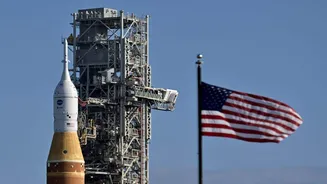
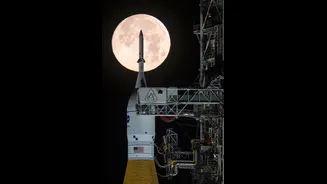
NASA's upcoming missions are designed to advance our understanding of lunar water and how to utilize it. The Artemis program aims at establishing a sustainable human presence on the Moon, and it will involve extensive exploration and resource utilization. The strategy focuses on the development of technologies for water extraction and processing. Researchers are studying methods to extract water from the lunar soil and convert it into usable resources. Additionally, new missions will focus on advanced mapping and analysis of lunar water ice deposits, helping refine our ability to estimate water reserves. Further, the creation of robust habitats and life-support systems will be necessary to ensure the survival of astronauts on the Moon. These missions also incorporate a collaborative effort that involves space agencies, universities, and private sector firms around the world. The cooperative environment will speed up scientific research and technology development.
Water's Impact on Life
The discovery of water on the Moon has significant implications for our understanding of life's origin and potential existence elsewhere in the universe. Water is vital for all known forms of life, and its presence provides a fundamental requirement for the development of life. The research into lunar water helps in evaluating whether life-supporting conditions existed in the early solar system. NASA's findings would offer a unique chance to study the conditions that made Earth habitable and to assess the possibility of finding life on other celestial bodies. Besides, lunar resources, like water, might be used to support long-duration space missions and set up permanent space settlements. This would enable scientists and researchers to further investigate the potential for life beyond Earth. Therefore, the study of lunar water, besides its scientific significance, gives hope for the future of space exploration and the possibility of discovering life elsewhere in the universe.