





Understanding NavIC
India's answer to global positioning, the Indian Regional Navigation Satellite System (IRNSS), widely known as NavIC, is a regional marvel designed to offer
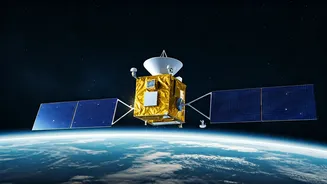
precise location services across the Indian subcontinent and its immediate surroundings. This constellation is comprised of seven satellites, a strategic mix of three in geostationary orbit and four in geosynchronous orbits, meticulously positioned to deliver accuracy better than 20 meters. NavIC functions by transmitting signals that enable users to determine their position. It offers two distinct service tiers: the Standard Positioning Service (SPS) available for all civilian users, and a Restricted Service (RS) exclusively for authorized entities, such as the military, which is encrypted for security. The utility of NavIC spans critical applications, from aiding in everyday navigation and detailed mapping to supporting disaster management efforts and facilitating the tracking of vehicles and individuals. Its integration into consumer electronics, including smartphones, is actively expanding its reach and accessibility to the public, underscoring its growing importance in everyday life and critical infrastructure.
The Atomic Clock Challenge
The critical backbone of any satellite navigation system lies in its atomic clocks, which provide exceptionally precise timekeeping essential for accurate positioning. Recently, reports surfaced regarding the malfunction of an atomic clock aboard one of the NavIC satellites. Such an event, by its nature, raises concerns about the potential impact on the system's overall accuracy and reliability. The functioning of navigation satellites relies on their ability to send precisely timed signals to receivers on Earth. The time it takes for these signals to travel is a key factor in calculating distance, and consequently, position. Therefore, any deviation or failure in the atomic clock's timing mechanism can lead to inaccuracies in the calculated location data. This specific incident involving the IRNSS-1F satellite, launched in March 2016, is significant as its on-board atomic clock stopped functioning. While the satellite itself is designed for a 10-year mission life and will continue to offer certain messaging services, the loss of its precise timing capability affects its contribution to the positioning data. This situation highlights the inherent complexities and vulnerabilities within advanced satellite systems, even those designed with redundancy.
ISRO's Assurance of Accuracy
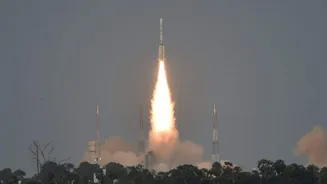
Despite the reported failure of an atomic clock in one of its NavIC satellites, the Indian Space Research Organisation (ISRO) has unequivocally stated that the NavIC system continues to operate with accuracy and reliability. This assurance stems from the robust and sophisticated design architecture of NavIC. The system is engineered to function effectively even in the event of a single satellite component failure, including an atomic clock. This resilience is achieved through a multifaceted approach that leverages data from multiple satellites simultaneously and employs advanced algorithms for position calculation. When one clock falters, the system's computational power can compensate by relying on the synchronized timing information provided by the remaining operational atomic clocks across the constellation. Furthermore, ISRO has been proactively addressing potential issues by planning for replacement satellites and upgrades. The recent launch of NVS-02, intended as a next-generation satellite, exemplifies this effort, though it faced its own orbital challenges. ISRO's commitment to maintaining NavIC's integrity underscores the importance of this indigenous navigation system for India's strategic and civilian needs, demonstrating a capacity to manage technical setbacks while ensuring service continuity.
NavIC's Role and Future
NavIC plays a pivotal role in India's technological self-reliance, providing a dedicated navigation service that is often more precise over the Indian landmass compared to global systems like GPS, whose signals arrive at an angle. The system's design, with satellites positioned directly above the region, enhances signal availability, particularly in challenging terrains like valleys and dense forests. This improved signal reception is crucial for applications where uninterrupted positioning is paramount. The challenges faced, including atomic clock failures and issues with satellite launches like NVS-02, are being addressed through ongoing advancements. ISRO is actively developing indigenous atomic clocks for next-generation satellites to mitigate past reliability concerns. These newer satellites also boast a longer mission life of 12 years and transmit signals on a third frequency band, L1, enhancing interoperability with other global navigation systems and enabling use in low-power wearable devices. Despite some historical delays in user segment development and past satellite mission failures, NavIC is steadily expanding its footprint, with data already integrated into aviation, shipping, and railway sectors, and increasingly appearing in smartphones, solidifying its position as a key indigenous technology.