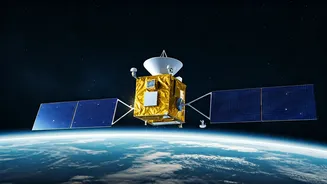









Launch and Constellation Formation
On March 10, 2016, the Indian Space Research Organisation (ISRO) successfully launched IRNSS-1F from Sriharikota aboard the PSLV-C32. This 1,425 kg satellite
joined its five predecessors, forming the foundational constellation for India's Regional Navigation Satellite System (NavIC). Positioned in a geostationary orbit at 32.5° East with a 5° inclination, IRNSS-1F was engineered for a service life exceeding 10 years. Its sophisticated payload included a navigation transmitter operating on L5 and S-bands, crucial for location services, and a C-band transponder paired with corner cube retroreflectors for precise ranging measurements. Following its launch, ISRO's Master Control Facility in Hassan swiftly established command over the satellite, orchestrating the seamless deployment of its solar panels within 19 minutes. This deployment was a critical step, enabling the satellite to commence its operational duties and paving the way for India's enhanced independence from global positioning systems, extending its coverage by 1,500 km beyond national borders for applications like vehicle tracking.
Mission Longevity and Atomic Clock
IRNSS-1F officially marked the completion of its designed 10-year mission life on March 10, 2026, a significant accomplishment for ISRO and India's space program. While its onboard atomic clock, procured from external sources, ceased functioning on March 13, 2026, the satellite continued to provide valuable services, particularly for one-way broadcast notifications. The precision of the Rubidium atomic clocks, essential for accurate timing in navigation, had encountered early challenges with two units failing before the mission's conclusion. Despite these setbacks, IRNSS-1F's resilience and extended operational period underscored the robustness of its design, validating earlier projections of its longevity. This remarkable endurance highlights ISRO's evolving expertise in critical satellite technologies, including the development of advanced atomic clocks now integrated into subsequent NavIC missions, like the NVS series, ensuring future-proofing and enhanced capabilities for the navigation system.
NavIC Applications and Future
IRNSS-1F has played a pivotal role in enabling a wide array of real-world applications, contributing significantly to societal welfare and national security. Its accurate time-stamping has been invaluable for mobile navigation, providing crucial advisories for fishermen at sea, and enhancing highway safety through precise vehicle tracking. In civilian contexts, the satellite has supported disaster response management and facilitated efficient fleet management, aligning perfectly with India's strategic autonomy goals. Even in its post-navigation role, IRNSS-1F continues to be utilized for one-way messaging, extending its utility without requiring full navigation functionality. NavIC's inherent advantage over GPS, particularly within India's challenging terrain, lies in its dual-frequency capability, which mitigates atmospheric interference. Looking forward, the NVS satellites are set to bolster the NavIC constellation, aiming to meet global navigation standards. IRNSS-1F's successful decade of service not only bolsters ISRO's reputation for cost-effective and reliable space missions but also supports ambitious projects like Gaganyaan. As acknowledged in internal ISRO documents, milestones like IRNSS-1F's contribute directly to 'enhancing regional navigation autonomy,' demonstrating the profound impact of indigenous technology.