






Relativity's Crucial Role
The Global Positioning System (GPS) has become an indispensable tool in our daily lives, guiding us through unfamiliar routes, tracking our movements,
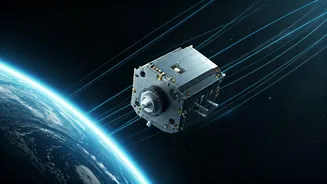
and even synchronizing time. However, the remarkable precision with which GPS operates owes a profound debt to Albert Einstein's revolutionary theories of relativity. These theories, specifically special and general relativity, describe how motion and gravitational forces influence the very nature of time and space. While these effects are often imperceptible in our everyday experiences, they become critically important when dealing with the extreme conditions encountered by GPS satellites, such as their high orbital speeds and the reduced gravitational pull at their altitude. Without meticulously accounting for these relativistic phenomena, the sophisticated system that allows us to navigate so effortlessly would quickly devolve into an unreliable mess.
Time Dilation: Speed's Effect
Einstein's special theory of relativity, published in 1905, introduces the concept of time dilation. This principle posits that time progresses at a slower rate for an object experiencing motion relative to an observer. The GPS satellites that form the backbone of the system traverse Earth's orbit at approximately 14,000 kilometers per hour. This considerable velocity causes the atomic clocks aboard these satellites to tick marginally slower than identical clocks stationed on Earth's surface. If this 'time dilation' effect were not factored into the GPS calculations, it would introduce an error of roughly 7 microseconds each day. This seemingly minuscule discrepancy, if uncorrected, would have a cascading negative impact on the system's accuracy over time.
Gravity's Influence on Time
Complementing special relativity, Einstein's general theory of relativity, developed in 1915, addresses the profound impact of gravity on the passage of time. This theory explains that gravity warps spacetime, and consequently, clocks situated in regions of weaker gravitational fields will run faster than those in stronger fields. GPS satellites are positioned at an altitude of about 20,200 kilometers above our planet, where the Earth's gravitational influence is significantly less pronounced compared to the surface. This diminished gravity causes the atomic clocks on the satellites to accelerate their pace, ticking approximately 45 microseconds faster per day than their terrestrial counterparts. This gravitational time dilation is a crucial factor that must be precisely managed for GPS functionality.
The Combined Relativistic Beat
When the effects predicted by both special and general relativity are considered in tandem, a net difference in the timing of GPS satellite clocks becomes apparent. The acceleration caused by weaker gravity (45 microseconds per day faster) is partially offset by the deceleration due to high speed (7 microseconds per day slower). The outcome is that the atomic clocks onboard GPS satellites actually run faster than clocks on Earth by a combined total of approximately 38 microseconds each day. This net acceleration, though small, represents a critical deviation from Earth-based timekeeping, and its precise magnitude is a direct consequence of the interplay between motion and gravitational forces as described by Einstein's theories.
GPS Accuracy Explained
The fundamental operation of the GPS system relies on trilateration, a process where your device determines its position by calculating the distance to multiple satellites based on the timing of signals they transmit. Each satellite broadcasts highly precise time data. Even the slightest inaccuracy in these time signals, if not harmonized with Earth-based clocks, can lead to substantial errors in calculating your location. A timing discrepancy of just 38 microseconds per day, as observed in the satellite clocks, would translate into a positional error of roughly 10 kilometers each day. Over extended periods, such an error would accumulate rapidly, rendering the GPS system utterly useless for accurate navigation and rendering your daily commute or travel plans unachievable.
Corrections for Precision
To counteract the effects of relativistic time dilation, the atomic clocks on board GPS satellites are meticulously calibrated and deliberately adjusted. The entire GPS system is engineered to incorporate corrections that compensate for both the slowing of time due to high velocity and the speeding up of time due to weaker gravity. These adjustments ensure that the timing signals received by your GPS device are synchronized with Earth-based time references. Without these sophisticated relativistic corrections, the GPS system would swiftly lose its accuracy and reliability, making it impossible to trust for critical navigation tasks. Therefore, every time you rely on your smartphone or a dedicated GPS unit to navigate, you are indirectly benefiting from and interacting with one of the most profound and counter-intuitive scientific insights ever developed.