



The Growing Debris Menace
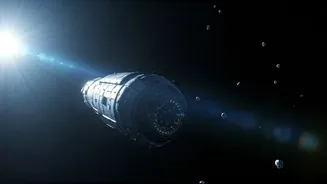
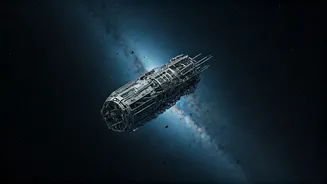
The expanse of space surrounding our planet is becoming increasingly cluttered with orbital debris, a significant concern for space agencies. This collection
includes defunct satellites, spent rocket stages, and fragments from past missions, all hurtling through space at incredible speeds. Scientists have long voiced worries about the potential for a cascade of collisions, a scenario known as Kessler Syndrome, where each impact could generate more debris, dramatically increasing the risk of further impacts. Millions of objects, some larger than a centimeter and countless smaller fragments, are estimated to be in orbit, posing a persistent threat to active spacecraft and future missions. The sheer volume and velocity of this material present a complex challenge for maintaining safe orbital environments and planning space exploration.
The Elusive Camera Target
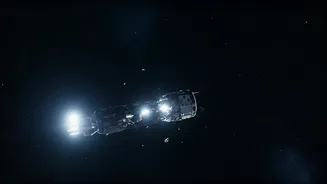
Despite the vast quantity of space junk, capturing it in photographs, especially from high-speed missions like Artemis II, is an extraordinarily difficult feat. The primary reason is size; most of this debris is too minuscule to be discernible by the human eye, let alone detailed in a photograph. While it's theoretically possible to photograph a larger piece of debris, the circumstances would need to be exceptionally precise. The extreme velocities at which both the spacecraft and the debris travel create a significant challenge for photography. Objects appear as fleeting blurs or are simply too far away and too small to register clearly in an image. The odds of obtaining a sharp, identifiable photograph of space junk are therefore exceedingly slim, making its absence in stunning mission photos not surprising.
Altitude and Focus Factors
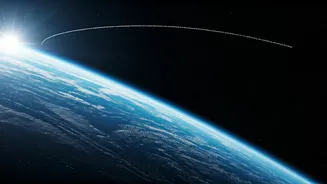
The location of space debris plays a crucial role in its invisibility. The densest concentrations of orbital junk are typically found in low Earth orbit, generally between approximately 466 and 621 miles above the planet's surface. During the critical initial phases of a space mission, such as the launch and ascent of Artemis II, astronauts are intensely focused on vital flight operations and navigation. This intense concentration on mission-critical tasks leaves virtually no opportunity to divert attention or camera equipment to scan for or photograph objects outside the immediate flight path. Furthermore, the spacecraft's rapid movement means that even larger debris would become indistinguishable within moments, making detailed photographic capture highly improbable.
Astronaut Safety Ensured
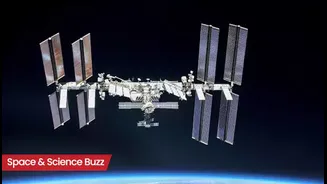
While space junk is challenging to photograph, it doesn't mean human spaceflight is entirely untouched by its presence. The International Space Station, for instance, frequently experiences impacts from tiny particles of debris. However, the station is engineered with robust shielding to withstand such minor collisions, and the probability of a significant, mission-threatening impact remains quite low. Space agencies employ sophisticated tracking systems that monitor potential hazards, providing advance warning and allowing for necessary maneuvers. Although the problem of space debris is indeed serious, it's important to remember that space is vast, and objects are separated by immense distances. This inherent spaciousness, combined with protective measures and advanced tracking, ensures astronaut safety remains a top priority during space missions.