







Automated Herd Movement
Forget early mornings and herding dogs. A new era in farming is here, where a farmer can simply use a mobile app to summon an entire herd of 600,000 cows
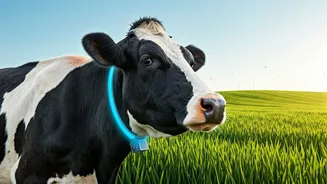
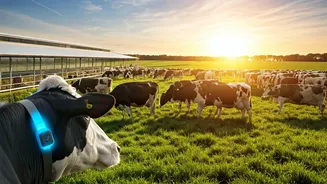
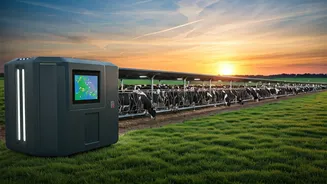
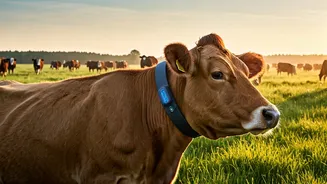
to milking stations. This innovation replaces laborious manual herding, which traditionally took nearly an hour, with a single tap. Each cow is equipped with a small device on its neck that, when activated, emits a sound. Through learned association, similar to how a dog learns commands, the cows understand this cue means it's time to move. This technological leap eliminates the need for physical fences, which are costly and require continuous upkeep. It addresses inefficiencies like daily herding, unnoticed health issues, and missed fertility windows that have plagued traditional farming for decades, offering a streamlined and highly efficient alternative. This system allows the entire milking shed to be filled autonomously and efficiently.
Virtual Fencing Explained
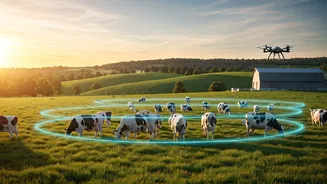
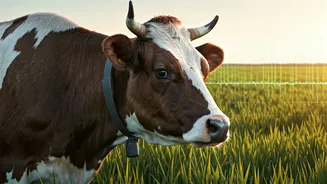
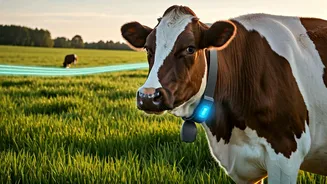
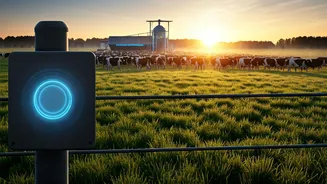
The core of this advanced system lies in its 'virtual fencing' capability. Farmers can utilize a smartphone application to draw a boundary on a satellite view of their land, much like outlining an area on a digital map. These digital boundaries are then instantly transmitted as GPS coordinates to the collars worn by every animal in the herd. Each collar meticulously tracks the cow's position multiple times per minute. As a cow approaches the designated virtual perimeter, the collar emits a specific sound on one side of its neck. Cows are trained to associate this sound with the instruction to turn away from the boundary. This behavioral conditioning ensures they remain within the set area without any human intervention, allowing them to graze freely and safely. This process occurs automatically, dozens of times daily, significantly reducing the need for physical barriers and constant supervision.
Pavlovian Training Success
The effectiveness of this system hinges on a sophisticated application of behavioral science, often referred to as a 'Pavlovian trick.' When a farm first integrates the technology, an intensive onboarding period of approximately one week is initiated. During this phase, the farmer physically guides the herd while the collars emit their programmed sound cues, reinforcing the desired movement. Each time a cow responds correctly to the auditory signal, the sound ceases, creating a positive reinforcement loop. This process quickly establishes a strong association between the sound and the correct action. Within a mere week, the animals learn to respond reliably to the algorithmic cues without direct physical guidance or the farmer's constant presence. The inherent social nature of cows further amplifies this learning, as the majority of the herd naturally follows the behavior demonstrated by a few trained individuals, accelerating the collective adoption of the system.
The Cowgorithm's Intelligence
Beyond managing movement, the smart collars are instrumental in continuous, in-depth monitoring of each cow. They meticulously track a range of vital indicators, including chewing habits, body temperature, walking patterns, rest periods, and even subtle fertility signals. This wealth of data is synthesized to create a unique behavioral profile for every single animal. The proprietary AI, affectionately dubbed the 'Cowgorithm,' has been trained on extensive datasets comprising hundreds of thousands of cows over several years, enabling it to understand typical behavior for each individual. If a cow deviates from its norm—perhaps by chewing less, exhibiting unusual movement, or showing other early indicators of illness—the system swiftly flags it. This early detection capability is crucial, often identifying potential health issues 24 to 48 hours before visible symptoms manifest, thereby significantly lowering treatment costs and improving recovery rates. Additionally, the system's precision in tracking fertility cycles, which are notoriously short, ensures farmers are alerted at the optimal moment, preventing delays and enhancing overall herd reproductive efficiency.
Financial & Growth Metrics
The impact of this technology is quantifiable, with users in the United States alone having established over 11,000 miles of virtual fencing, a distance comparable to the circumference of the continental United States. This has translated into an estimated $220 million in savings on traditional fencing expenditures. Currently, the system manages herds totaling more than 700,000 cattle across New Zealand, Australia, and 22 states within the U.S. The company operates on a recurring revenue model, with subscription fees ranging from $5 to $8 per cow per month. The collars are provided on a lease basis, not for outright purchase. For a farm with approximately 500 cows, this translates to a monthly cost of around $3,000, with larger operations incurring proportionally higher fees. Once a farm integrates this digital infrastructure into its operations, transitioning away becomes a complex undertaking due to the system's deep entrenchment.
The Billion-Dollar Vision
The significant backing from prominent investors, including Peter Thiel's Founders Fund, underscores the transformative potential of this venture. Founders Fund has been a consistent supporter since the company's early stages in 2018. Their continued investment, culminating in leading a recent funding round that values the company at approximately $2 billion, signals strong confidence in both the groundbreaking technology and its long-term viability. This substantial valuation is a testament to the innovation's capacity to redefine agricultural practices and its broader implications beyond the farm gate. It highlights how a company, initially focused on solving specific farming challenges, has developed a versatile platform with applications in diverse fields.
Beyond Agricultural Frontiers
At its core, this innovation represents a sophisticated system capable of orchestrating the real-time movements of thousands of living animals through the intelligent application of data, sensors, and behavioral cues. While its current application is firmly rooted in agriculture, the underlying principles possess far-reaching potential. These same concepts could be effectively adapted for applications such as wildlife management, optimizing logistical operations, and advancing robotics. More profoundly, it signifies a paradigm shift in how physical environments are managed. Tasks that historically demanded continuous human oversight and strenuous physical effort can now be efficiently guided by software systems operating autonomously in the background. Furthermore, it addresses critical labor challenges prevalent in agriculture, a sector often characterized by physically demanding work and a diminishing labor force. By reducing the need for manual intervention and elevating efficiency, this technology offers a sustainable path forward.