





Pollution Plagues Coastline
An unsettling reality has emerged for Goa, a state heavily reliant on both its vibrant tourism sector and its traditional fishing industry: the coastal
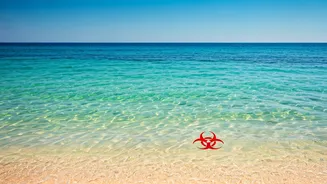
waters surrounding its well-known beaches are significantly polluted. Recent assessments indicate that these waters fail to meet the Central Pollution Control Board's (CPCB) stringent criteria for SW-II categorization. This classification signifies that the water quality is compromised, making it unsuitable for essential activities like bathing, engaging in contact water sports, and conducting commercial fishing operations. The implications are far-reaching, impacting the very fabric of Goa's economy and the daily lives of its residents who depend on these natural resources.
Faecal Contamination Levels
Consistent testing has revealed alarmingly high levels of faecal content in Goa's coastal waters, far exceeding the limits established by the CPCB. This contamination is not confined to a few isolated spots but has been detected across many of the state's major beaches. Disturbingly, this issue also extends to three of the four designated nesting sites for the endangered olive ridley turtles: Morjim, Galgibaga, and Agonda. Furthermore, a significant number of Goa's rivers are also showing elevated faecal coliform levels, with some instances recording concentrations up to 300% higher than the permitted norms during certain months. This widespread contamination poses a direct threat to marine ecosystems and public health.
Widespread Beach Contamination
Data presented in the ongoing assembly session, as per a reply tabled by Chief Minister Pramod Sawant, who also oversees the environment portfolio, highlights the broad scope of the problem. For the 2024-25 period, coastal waters in numerous locations consistently tested high for faecal content. These affected areas include Tiracol, Miramar, Bambolim, Calangute, Baga, Morjim, Vagator, Arambol, Baina, Colva, Benaulim, and Palolem. Even a secluded beach like Rajbhag in Canacona, typically considered remote, was found to be polluted based on tests conducted by the Goa State Pollution Control Board as part of a national water quality monitoring initiative. This indicates a systemic issue affecting the state's entire coastline.
River and Waterway Pollution
The grim picture extends beyond the beaches to Goa's vital river systems. Investigations have found that many rivers, not just the well-known Mandovi and Sal, are contaminated with sewage waste. Tests conducted on various rivers, including Tiracol at Keri-Pernem, Chapora near Siolim bridge, and Sinquerim on the Candolim side near the Ganpati temple, all showed high levels of faecal coliform. The Zuari river, tested at Panchawadi, Cortalim, Madkai jetty, and Borim bridge, also registered concerning faecal contamination. Even the Valvanti river in Sanquelim experienced faecal coliform levels exceeding permissible limits during September 2024. This pervasive contamination of waterways poses a significant risk to drinking water sources and aquatic life.
Understanding Faecal Coliform
The permissible limit for faecal coliform, a key indicator of sewage contamination, is set at 100 MPN (most probable number) per 100ml. Faecal coliform MPN is a statistical method employed in water quality assessments to estimate the concentration of viable microorganisms, such as E. coli. This estimation is achieved by observing fermentation in diluted water samples. For example, in July 2024, the faecal content in Tiracol was recorded at a staggering 3,300 MPN per 100ml, vastly exceeding the standard limit of 100 MPN per 100ml. This stark difference underscores the severity of the pollution affecting Goan waters, indicating significant human or animal waste input.
Government Action Promised
In response to the alarming findings, the Chief Minister has indicated that steps are being taken to address the pollution crisis. The Water Resources Department has been instructed to take immediate action to prevent sewage discharge directly into the rivers. This directive aims to curb the primary source of contamination and improve the overall water quality of the state's waterways. While these measures are a step in the right direction, the extent of the existing pollution suggests that comprehensive and sustained efforts will be required to restore Goa's beaches and rivers to a safe and healthy state for both its residents and its vital tourism industry.