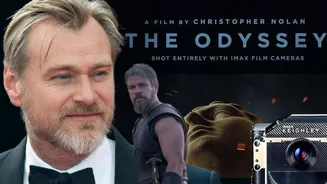

As of Christmas Day 2025, the internet is buzzing with the debut trailer for Christopher Nolan's The Odyssey — the first major theatrical feature ever
shot entirely on IMAX 15/70mm film cameras. Released just yesterday (December 24, 2025), the footage has reignited excitement for Nolan's ambitious adaptation of Homer’s epic, starring Matt Damon as Odysseus, alongside Tom Holland, Anne Hathaway, and a star-studded ensemble. What makes this project truly historic, and extraordinarily expensive, is Nolan’s commitment to physical large-format film. Traditional IMAX cameras were bulky, loud, and dialogue-unfriendly, often limited to select action sequences. Nolan pushed IMAX to innovate, resulting in the new Keighley camera (named after the late David Keighley, IMAX’s first Chief Quality Officer who passed away in August 2025, and his wife Patricia, IMAX’s ongoing Chief Quality Guru). This updated design is lighter, features a specialised “blimp” housing that reduces noise by about 30%, and includes modern aids like an improved viewfinder enabling clean, on-set dialogue recording for the first time in a full narrative feature. Nolan confirmed the production shot over 2 million feet of Kodak 65mm negative film during the 91-day shoot (February to August 2025), spanning locations from Morocco and Greece to Iceland and the open ocean. That’s roughly 100+ hours of raw footage — a massive shooting ratio reflecting Nolan’s perfectionist style. Breaking Down the Film Stock Cost' At current Kodak pricing for 65mm motion picture negative (for example, the VISION3 series), a 1,000-foot roll costs around $1,500–$2,000. Industry reports from 2025 cite roughly $1.50 per foot, or $1,500 per 1,000 feet, for standard colour negative stock. For 2 million feet, the raw numbers look like this:
- Raw negative cost: ≈ $3 million USD (precisely $3 million at $1.50 per foot, as widely reported by Variety, PetaPixel, and others)
This figure covers raw stock only.
Additional expenses include:
- Development and lab processing — Large-format 65mm/70mm labs charge premium rates, often $0.40–$1+ per foot, depending on volume and services
- Waste from high shooting ratios — Feature films commonly expose 10–30× more footage than the final cut
- Camera rentals, custom modifications, and specialised crew — IMAX film gear is rare and costly to operate
Taken together, the total film-related budget for The Odyssey likely exceeds $10–20 million when factoring in all photochemical steps — a staggering sum in an era dominated by digital workflows.
For comparison, a standard 35mm feature would typically spend far less, with film stock costing roughly $500–$700 per 1,000 feet and offering longer run times per load.
Why Pay the Premium? The IMAX Advantage
The overall production budget for The Odyssey is estimated at $250 million, making it Nolan’s most expensive film to date and a high-stakes bet on physical filmmaking’s enduring power.
Nolan has long championed film for its “weight and credibility.” The IMAX 15/70mm format delivers unparalleled resolution (approximately 70 megapixels per frame), an immersive 1.43:1 aspect ratio, and organic grain that digital formats struggle to replicate.
Crucially, the new Keighley camera’s quieter operation allowed intimate, whispered dialogue scenes — previously impossible without extensive ADR (automated dialogue replacement).
The result is a mythic action epic designed for giant IMAX screens, capturing the primal terror and wonder of Odysseus’ journey through real locations, practical effects, and tangible scale.
Advance tickets for 70mm IMAX screenings sold out nearly a year early in many locations, underscoring audience demand for this experience. In a streaming-saturated world, The Odyssey (releasing July 17, 2026) serves as a reminder of why some filmmakers still invest millions in celluloid.
As Nolan himself has said, he is filling “gaps in cinematic culture” — and the price tag shows just how epic that pursuit has become.