





Seamless Booking Experience
Initiating a journey in Abu Dhabi's autonomous taxi service mirrors the familiar process of booking any regular ride. Passengers simply open their preferred
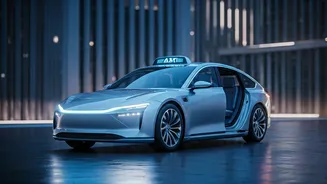
application, input their destination, and will notice a new service category labeled 'Autonomous' alongside traditional options like UberX or Black. This distinctive option is exclusively available within a precisely defined operational zone on Yas Island. Upon selecting this service, the system efficiently identifies and assigns an available self-driving vehicle nearby, paralleling the established procedure for human-operated rides. Upon the vehicle's arrival, passengers authenticate their access through the app. These sophisticated autonomous cars are equipped with approximately 20 diverse sensors, encompassing both cameras and LiDAR units, which continuously work to map and comprehend their surroundings in real-time. For stringent safety compliance in Level 4 autonomous operations, the driver's seat is physically secured and covered, preventing any unauthorized interaction. Interestingly, the traditional space for the driver's seat has been repurposed to offer convenient luggage storage.
Advanced Safety Protocols
Once settled inside, passengers are prompted to fasten their seatbelts, a prerequisite before the vehicle can commence its journey. The ride can be initiated either through the intuitive mobile application or via a touchscreen interface integrated within the vehicle's cabin. It's acknowledged that first-time users might experience a degree of apprehension, but rest assured, the system conducts comprehensive pre-operational checks to ensure utmost safety, which remains the paramount concern. During the ride, passengers will observe that the acceleration and braking are remarkably smooth and precisely controlled. This deliberate calibration is a hallmark of the autonomous system, which is in a perpetual state of learning and refinement, akin to a dynamic, evolving entity. The technology partner collaborates by amassing extensive real-world data from various urban environments. This data collection is crucial for ensuring the driving behavior is predictable, consistently safe, and adeptly adapted to the specific nuances of local driving conditions. Furthermore, multiple safety redundancies are woven into the passenger experience. Should a rider feel any discomfort or perceive an anomaly, a dedicated support button is readily accessible both within the app and on the in-car display. Activating this button instantly establishes a connection with Uber Support. Passengers also retain the ability to terminate the ride prematurely, with the vehicle programmed to safely pull over at the most suitable nearby location.
Scaling and Hybrid Model
Despite the remarkable advancements in autonomous technology, widespread implementation presents ongoing challenges, particularly within emerging markets. These hurdles can be broadly categorized into two main areas. Firstly, the technology itself necessitates extensive, rigorous testing in each unique geographical setting before confidence in its safety can be established; this remains an continuous evolutionary process. Secondly, the commercial viability of autonomous vehicles is a significant consideration. The development and deployment of these vehicles are exceptionally costly, owing to their intricate hardware and sophisticated software systems. This naturally leads to questions about the optimal quantity of such vehicles that can be effectively deployed in any given city. The company's distinct advantage lies in its capacity to manage a diversified marketplace. By operating both human-driven vehicles and autonomous cars within the same urban landscape, it can present riders with a choice between the two. The application is intelligently designed to ascertain the most suitable option for the rider at any given moment, thereby guaranteeing service reliability while facilitating the sustainable expansion of autonomous operations.