







Driving Towards Autonomy
Uber is embarking on an ambitious transformation, moving beyond its core ride-hailing services to become a foundational pillar for the autonomous vehicle
(AV) industry. The company's novel strategy involves leveraging its extensive global network of millions of drivers, essentially converting their everyday driving into a source of high-fidelity data. By equipping driver-operated vehicles with sophisticated sensor technology, Uber intends to establish the most extensive real-time data collection system worldwide. This data will be crucial for training the artificial intelligence that will underpin the self-driving systems of tomorrow, marking a significant pivot in Uber's long-term strategic vision. The objective is to create a robust infrastructure for the burgeoning AV sector, building upon the company's established logistical capabilities.
The AV Labs Initiative
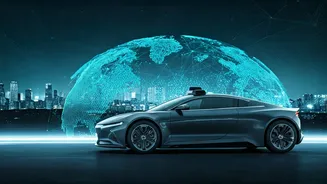
At the heart of this transformative endeavor is the recently launched Uber AV Labs, a specialized division focused on accelerating the progress of autonomous mobility. This division's primary function is to collect and disseminate massive volumes of real-world driving data. While the program is currently in its nascent stages, characterized by a modest fleet of sensor-outfitted vehicles such as the Hyundai Ioniq 5, the aspiration is to progressively scale this technology across the entire Uber platform. According to Chief Technology Officer Praveen Neppalli Naga, the biggest obstacle for AV developers has evolved from software coding challenges to the critical need for acquiring diverse and extensive training data. Uber's unique market position makes it exceptionally well-suited to fulfill this demand, providing the essential datasets to advance AV capabilities significantly.
Crafting the AV Cloud
A cornerstone of this strategic shift is the development of a sophisticated AV Cloud, envisioned as a searchable repository teeming with multi-sensor data. This innovative platform will grant partner companies access to highly specific datasets, illuminating how vehicles navigate intricate road scenarios like complex intersections or react to unpredictable weather conditions. Such granular information is indispensable for achieving 'Level 4' autonomy, a significant milestone in self-driving capabilities. Uber has already forged strategic alliances with approximately 25 autonomous technology firms, including prominent entities like NVIDIA and Wayve. These collaborations are vital for supplying the raw telemetry and visual data necessary to refine the machine-learning models that power these advanced autonomous systems.
Ensuring Data Safety
Uber's leadership has consistently emphasized that the overarching goal of this initiative is to 'democratize' access to valuable data, rather than prioritizing immediate financial gains. By furnishing unblurred, high-resolution video footage that enables AI systems to discern subtle, crucial details like pedestrian eye contact or head movements, the company asserts that it can substantially enhance safety margins across the entire autonomous vehicle industry. This method, often referred to as 'shadow mode' testing, allows AI systems to virtually practice making decisions during actual road journeys without directly controlling the vehicle. This approach provides a secure yet remarkably effective training environment, crucial for developing robust and dependable self-driving technology for widespread public adoption.
Charting the Future
This decisive move towards a data-centric operational model is strongly aligned with Uber's broader objectives for 2026, which include offering autonomous ride services in 15 distinct cities. Furthermore, the company aims to become the preeminent global facilitator of AV trips by the year 2029. By harmoniously integrating its digital infrastructure with its physical operational footprint—combining precise geospatial mapping with invaluable real-world sensor data—Uber is fundamentally evolving. It is transitioning from being solely a service provider to becoming an essential, foundational engine driving the development and deployment of the next generation of global transportation systems.