






Galactic Collisions Explained
Galaxies, like majestic islands in the vast cosmic ocean, are not static entities. They move, interact, and, sometimes, collide. These collisions, while
seemingly destructive, are vital in the grand scheme of galactic evolution. It's not a head-on smash, but rather a slow dance of gravitational forces. As galaxies approach, the gravity of each begins to warp and pull the other. The stars themselves usually don't collide; the distances between them are immense. Instead, the galaxies merge, reshaping each other in a process that can last hundreds of millions of years. This cosmic dance has profound implications, and one of the most exciting is its impact on the supermassive black holes that reside at the heart of most galaxies. These black holes are incredibly dense regions of space with a gravitational pull so strong that nothing, not even light, can escape.
Supermassive Black Holes
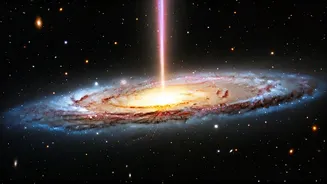
Supermassive black holes (SMBHs) are the giants residing at the centers of nearly all large galaxies. Their masses range from millions to billions of times the mass of our Sun. While often depicted as cosmic vacuum cleaners, SMBHs are more complex. They don't just passively sit; they actively influence their surroundings. When material like gas and dust falls into a black hole, it forms a swirling disk called an accretion disk. The friction in this disk heats the material to extreme temperatures, causing it to emit immense amounts of radiation across the electromagnetic spectrum, including X-rays and visible light. This radiation can affect the galaxy by heating and ionizing the surrounding gas, and by driving powerful outflows, influencing star formation and galaxy growth. When a black hole is actively accreting matter, it's considered to be in an active galactic nucleus (AGN) phase. The brightness of AGNs can outshine entire galaxies, making them some of the most luminous objects in the universe.
Euclid's Revelations
The Euclid space telescope, designed to explore the evolution of the dark universe, has provided crucial evidence linking galaxy collisions to the activation of SMBHs. Euclid's observations showed a clear correlation: galaxies undergoing collisions or mergers are much more likely to host an active SMBH. The Euclid data allowed astronomers to analyze a large sample of galaxies and measure their properties, including the activity of their central black holes. By comparing the behavior of SMBHs in merging galaxies with those in isolated galaxies, researchers confirmed that the interaction of two galaxies can trigger the black hole's feeding frenzy. This is a significant step forward in understanding how these cosmic giants come to life and influence their galactic homes. These findings support theoretical models and simulations of galaxy evolution and SMBH growth.
Implications of the Findings
These findings have wide-ranging implications for our understanding of galaxy evolution. They provide compelling evidence for the role of galaxy mergers in fueling the growth of SMBHs, and this, in turn, influences the evolution of galaxies. When black holes become active, they release enormous amounts of energy. This energy can affect the surrounding gas and dust, either fueling or suppressing star formation. The newfound connection between galactic collisions and black hole activation helps explain the observed patterns of galaxy growth and the distribution of SMBHs in the universe. Understanding how these processes work is key to piecing together the full story of cosmic evolution and the intricate relationships between black holes and their galactic hosts. The data from Euclid is already helping astronomers refine their models of galaxy evolution.
Looking Ahead
The study's findings are a stepping stone in the ongoing research into the cosmos. Future studies will delve deeper into the details of these interactions. Future observations from Euclid and other telescopes will contribute more. They will examine how the collision dynamics influence the black hole's activity. The study's focus extends to understanding how the energy released by active black holes shapes their host galaxies. The Euclid mission is still in its early stages, and there are many more discoveries to be made. Scientists are using Euclid's data to explore other aspects of galaxy evolution, dark matter, and dark energy. The discoveries will provide a more detailed understanding of the universe.