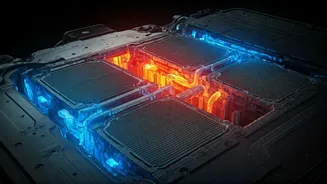








The Heat Challenge
While electric vehicle discussions often focus on battery range and charging speeds, the sophisticated management of heat within the vehicle is equally
vital. This isn't just about general cooling; it's about precisely controlling how heat moves through various components, where it accumulates, and how rapidly it can be dissipated or rerouted. This nuanced approach to thermal control is where material science plays a pivotal role, underpinning the performance, safety, and enduring reliability of EVs. Understanding this complex interplay of heat and materials is key to unlocking the full potential of electric mobility.
Unpredictable Heat Spikes
A significant hurdle in EV thermal management stems from the non-uniform and unpredictable nature of heat generation. Unlike a steady-state system, an EV's thermal load can fluctuate dramatically within minutes. Activities like rapid charging, aggressive driving, or even shifts in ambient temperature can cause sudden, intense heat spikes in the battery pack. The challenge, therefore, isn't merely to expel heat but to expertly manage these uneven surges. This requires a sophisticated control strategy that ensures thousands of individual battery cells maintain optimal operating temperatures within a very narrow range. Failure to preserve this balance can lead to a gradual, and sometimes irreversible, decline in performance.
Beyond Cooling Systems
While advanced cooling systems, featuring liquid loops, optimized airflow, and integrated heat exchangers, are standard in modern EVs, their effectiveness is significantly limited without the right materials. Even the most meticulously designed cooling architecture will fall short if the materials within it do not facilitate efficient heat transfer. Heat requires dedicated pathways and seamless continuity to move effectively, particularly across component interfaces. This is where the expertise of material science becomes indispensable, providing the crucial elements that enable thermal energy to travel where it needs to go, rather than becoming trapped.
Thermal Interface Materials
Thermal Interface Materials (TIMs) are indispensable in addressing a subtle yet critical issue: the imperfect contact between solid surfaces. At a microscopic level, even seemingly smooth surfaces have tiny gaps filled with air, which is a poor conductor of heat. TIMs are applied between components, such as battery cells and cooling plates or power electronics and heat sinks, to fill these microscopic voids. This ensures that thermal energy is efficiently transferred rather than being obstructed. Modern TIMs are highly customized, with engineers now selecting them based on specific application needs like surface irregularities, pressure constraints, and the variability of thermal loads, demonstrating their crucial role in achieving expected system performance.
Phase Change Materials
For thermal issues characterized by sudden, intense spikes, such as those encountered during rapid charging or aggressive acceleration, Phase Change Materials (PCMs) offer a valuable solution. Unlike conventional cooling systems that might struggle to keep pace with rapid heat generation, PCMs act as temporary thermal buffers. They absorb excess heat by undergoing a phase transition, effectively storing the thermal energy instead of immediately dissipating it. This stored energy is then released later. By moderating temperature fluctuations, PCMs help stabilize thermal conditions, which directly contributes to optimizing EV performance, especially in scenarios where consistent operation is paramount.
Lightweight Materials' Dual Role
The drive to reduce weight in electric vehicles for improved efficiency has evolved, with materials now expected to perform a dual function. Contemporary lightweight materials are designed not only to minimize mass but also to actively participate in thermal management. This has led to an increased adoption of materials like aluminum-based composites, graphite-enhanced structures, and thermally conductive polymers. These advanced materials transcend their purely structural roles to become integral parts of the thermal pathway within the vehicle. In the constrained spaces of EV architectures, this combined capability of reducing weight while managing heat is becoming increasingly essential.
Safety Through Materials
Thermal management is intrinsically linked to vehicle safety, particularly concerning battery systems. The primary concern when a battery cell overheats isn't the damage to that single cell, but the potential for that heat to propagate to adjacent cells, leading to an uncontrolled thermal event. High-performance materials are crucial in mitigating these risks by deliberately slowing down heat transfer. This includes the use of flame-retardant polymers to delay ignition, ceramic barriers designed to withstand extreme temperatures, and aerogels engineered to limit heat diffusion between cells. These materials effectively 'buy time,' which is a critical factor in maintaining battery safety and performance during thermal incidents.
Reliable Liquid Cooling
Liquid cooling remains a dominant strategy for high-performance EVs due to its inherent efficiency. However, translating theoretical efficiency into long-term real-world durability requires careful material selection. Coolants can degrade materials over time, seals may weaken, and corrosion can accumulate, compromising the integrity of the cooling system. Therefore, material choices within these systems are increasingly strategic, focusing not only on thermal conductivity but also on chemical compatibility, long-term stability, and resistance to wear. Without these attributes, even sophisticated liquid cooling designs can lose effectiveness over time, underscoring the importance of robust materials.
Evolving Air Cooling
While often overlooked, air cooling continues to be a viable option, particularly for smaller or more economical electric vehicles. The modern approach to air cooling involves a more sophisticated integration with other materials designed to enhance heat distribution. This synergy allows for more effective thermal management than traditional airflow alone, making these systems increasingly practical. Although perhaps not as potent as liquid cooling, air-cooled solutions offer simplicity and lightweight benefits, making them ideal for applications where these characteristics are prioritized.
Integrated Thermal Solutions
The most significant advancements in EV thermal management are emerging from the integration of multiple strategies rather than relying on a single solution. A sophisticated thermal management system today might combine TIMs for efficient heat transfer at component interfaces, PCMs to absorb and buffer heat spikes, and advanced structural materials to effectively distribute heat across larger areas. This layered approach creates comprehensive heat dissipation technologies capable of managing both steady-state thermal conditions and sudden peak demands more effectively, leading to enhanced overall system performance and reliability.